


-
1940s

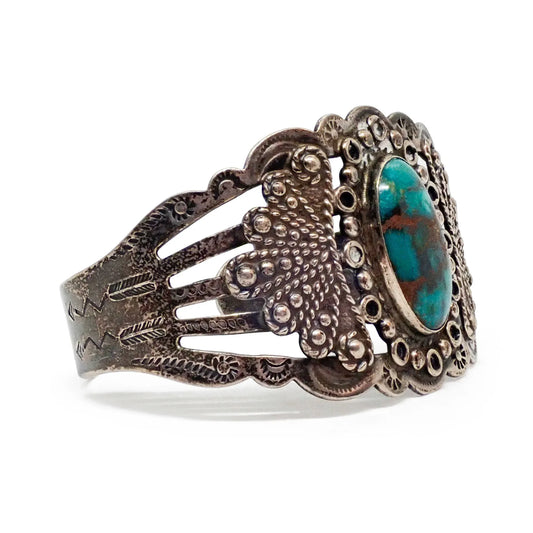
1940s Harvey Era High-Grade Natural Turquoise Sterling Silver Navajo Cuff Bracelet by SILVER ARROW
Regular price $620.00 USDRegular priceUnit price per


1940s Harvey Era High-Grade Natural Turquoise Sterling Silver Navajo Cuff Bracelet by SILVER ARROW
✨Collectors Circle Members receive a welcome offer
At a Glance:
Design: Late Harvey Era Silver Arrow sterling silver cuff bracelet with oval turquoise cabochon, split shank construction, and applied silverwork
Stone: High-grade turquoise cabochon visually consistent with Nevada material
Color: Teal-blue turquoise with dark rust-brown matrix and deeper blue-green movement
Accent: Alternating silver beads, hollow circular appliqués, rope wire, stamped borders, and applied side panels
Metal: .925 sterling silver
Maker: Silver Arrow | a commercial workshop & manufacturer
Era: Circa 1940s
Status: Sterling silver turquoise cuff bracelet, hallmarked by the shop
Condition: Excellent — see SCJ Vintage Condition GuideSpecifications:
- Wear scale: domed stone profile with visually substantial face and comfortable medium-scale wrist presence
- Stone: 7/8" x 1" (bezel to bezel)
- Face width: 1 1/2"
- Inside length: 5 5/8"
- Gap: 7/8"
- Total inside circumference: 6 1/2" (M per SCJ size guide)
- Weight: 35.7 grams
Gallery Note:
Many Harvey-era cuffs have survived. Far fewer still feel this alive today.
This signed Silver Arrow bracelet carries museum-caliber preservation and striking visual energy — from its luminous domed turquoise to the crisp silverwork and interior hallmark, all of it arriving eighty years later with unusual strength. A quiet conversation piece for the collector who notices.
The oval saturated cabochon rises in a smooth dome with a moody blue-green hue, dark rust-toned matrix, and a polished surface that still catches the light — more commanding than the small stones typically found in lighter tourist-period bracelets.
The silverwork earns equal attention. Rounded beadwork, well-defined circular appliqués, and textured rope wire panels build a face with genuine density — elaborate where most Harvey-era cuffs are simple, dimensional where others are flat.
What separates this cuff is how completely those qualities have held together: stone, silver, and hallmark intact, none softened by the decades. History and structure, worn in balance.
Hallmark & Maker Notes:
This cuff is stamped STERLING and Silver Arrow on the interior. The sterling mark is crisply struck inside the fletched end of a long arrow that flows directly into the elegant cursive Silver Arrow hallmark running toward the arrow's tip — an exceptionally clean example of the signature.
Silver Arrow belongs to the mid-century Harvey jewelry story rather than to a single artisan signature — and its role in that story was significant. Rather than a destination shop where tourists stopped to browse, Silver Arrow operated as a major wholesale supplier, moving Indian-design silver jewelry through trade networks, curio shops, and commercial channels across the Southwest. In Fred Harvey Jewelry: 1900–1955, jewelry historian Dennis June documents Silver Products Manufacturing Co. of Kansas City, Missouri, as a prominent company producing silver Indian-design jewelry during the 1940s. June describes the company's evolving mark sequence and notes that Harvey jewelry bearing these stamps is enthusiastically collected today.
Three distinct stamp variations help place Silver Arrow pieces accurately within that history. The earliest, used in the late 1930s and early 1940s, is a blocky SILVER PRODUCTS COIN SILVER stamp paired with an arrow symbol, reflecting the company's origins in coin-alloy production. That practice was already fading by the time Silver Arrow emerged — Mexican peso melting had been largely phased out as coin export to the American Southwest was restricted, and sterling ingots in standardized sheet and wire form had become the industry standard. American coins had effectively left the jewelry bench decades earlier, when defacing U.S. currency was outlawed in 1890.
By the 1940s, Silver Arrow had transitioned to its second and most recognizable mark: the long running script Silver Arrow name paired with a STERLING stamp placed inside the arrow's fletching. This is the mark on this cuff, used extensively through the company's active Southwest trade routes. A third and final mark — a tighter corporate block stamp registered as SILVER ARROW-STERLING around 1950, recorded in registries including Lang Antiques — reflects the postwar period, when standardized retail classification reshaped how makers identified their work.
Because this cuff carries the long script-and-arrow hallmark with STERLING struck inside the feathered end, it aligns with the Stamp 2 production period, supporting a 1940s placement. That distinction matters to collectors because it links the bracelet to the company's most active Harvey-era output, not simply to the Silver Arrow name in general.
Secondary market research adds geographic depth to that placement. The workshop's production roots trace to Albuquerque, New Mexico, where it was established in 1938, with operations later relocating to San Luis, Colorado, before the company closed its commercial routes in the 1950s. Registered as a Midwestern business entity for distribution purposes, Silver Arrow's working history was distinctly Southwestern — and the jewelry reflects it. The company frequently employed machine-assisted die-striking to process sheet silver while relying on regional indigenous silversmiths for hand-stamping, stone-setting, and bench-finishing. This cuff, with its layered construction and carefully worked face, represents that collaborative process at a high level of execution.
✨ Collector inquiries are welcome. SCJ is open to thoughtful questions, documented observations, and new information that deepens the story of a piece. With permission, selected collector notes may be featured in our upcoming Collectors Circle Insights publications.
$620.00
-
Royston District Turquoise

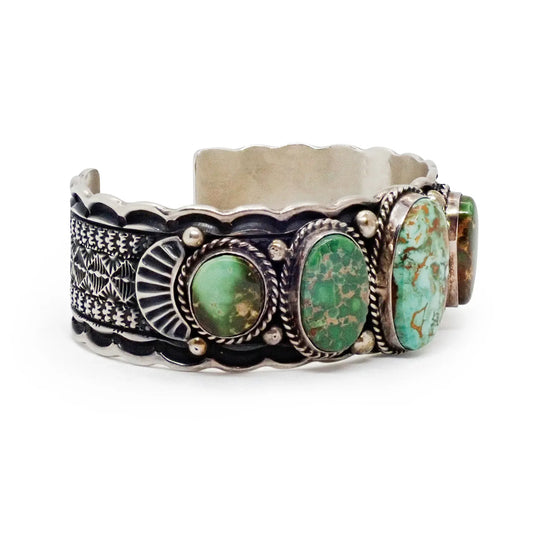
Native American Navajo Royston Turquoise Row Stamped Sterling Silver Cuff Bracelet by G. HOSKIE
Regular price $1,488.00 USDRegular priceUnit price per


Native American Navajo Royston Turquoise Row Stamped Sterling Silver Cuff Bracelet by G. HOSKIE
At a Glance:
Five-stone turquoise row cuff bracelet by Navajo silversmith Guy Hoskie
Stones visually consistent with Royston district material
Intricate stampwork extending across the cuff shoulders
Balanced medium statement cuff with strong collector appealBracelet Features:
- .925 sterling silver
- Five natural turquoise cabochons with blue-green & deeper green tones
- Deep hand-stamping & vintage revival oxidation
- Heavy-gauge sterling silver construction
- Hallmarked by the maker
- Condition: Excellent — see SCJ Vintage Condition Guide
Bracelet Specifications:
- Wear scale: medium statement cuff with pronounced presence
- Center turquoise: 1" x 1/2" (bezel to bezel)
- Face width: 7/8"
- Inside length: 5 1/2”
- Gap: 7/8”
- Total inside circumference: 6 3/8" (S per SCJ size guide)
- Weight: 63.5 grams
ABOUT THIS PIECE:
This signed Guy Hoskie cuff presents a five-stone turquoise composition with strong visual rhythm and clear material presence. The cabochons move through shades of blue, green, and deeper moss tones, each marked by its own matrix patterning. Rather than aiming for strict uniformity, the bracelet allows that natural variation to become part of the design, creating a Royston-associated palette with depth, contrast, and cohesion.
The silverwork is deliberate and structurally strong. Each stone is set in a smooth bezel, framed with twisted wire, and distributed across a raised outer plate, creating a subtle sense of dimension over the solid inner cuff. Deep stampwork continues through the shoulders and out to the terminals, extending the visual interest well beyond the central setting. The result is a controlled surface work that supports the stones and gives the bracelet a fully resolved profile from end to end, without excess.
The piece reads as confident rather than overstated. Its strength comes from proportion, surface, and material balance: substantial silver, well-chosen turquoise, and stampwork used with purpose. For collectors of signed Navajo jewelry, it offers the combination that matters most—strong stones, convincing structure, and a fully integrated design.
ARTISAN NOTE:
Guy Hoskie is a Navajo silversmith whose work is associated with deep stampwork, substantial silver construction, and strong set-stone compositions. Southwestern galleries consistently identify him as Sunshine Reeves’ brother-in-law, placing him within a family circle known for heavily worked silver and bold stamp patterns. Market-circulated biographies also suggest that he learned the craft from or alongside relatives, especially Sunshine Reeves and Andy Cadman.
Other biographical details repeated across dealer and gallery sources remain unverified. These include claims that he worked for the Navajo Tribe in Window Rock from 1975 to 2000 while making jewelry on the side, became a full-time artisan in the early 1990s, was born in 1952, was born in Fort Defiance, Arizona, later lived in Window Rock, and had family and military ties noted in dealer biographies. These points may offer useful directions for future research, but they should not be treated as independently confirmed.
PERFECT FOR:
- Collectors of signed Navajo silverwork with strong stampwork traditions
- Royston turquoise collections focused on natural color variation
- Curated bracelet groupings anchored by a central statement cuff
- Anyone who appreciates substantial, bench-fabricated Southwestern silverwork
✨ Collectors Circle members receive a welcome offer on their first purchase.
$1,488.00
-
1970s Chip Inlay

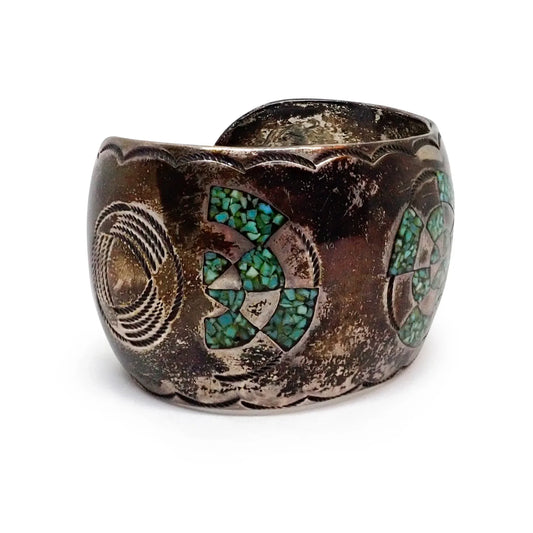
Circa 1970s Native American Navajo Turquoise Mosaic Chip Inlay Hand-Engraved Sterling Silver Cuff Bracelet
Regular price $517.00 USDRegular priceUnit price per


Circa 1970s Native American Navajo Turquoise Mosaic Chip Inlay Hand-Engraved Sterling Silver Cuff Bracelet
Overview:
Circa 1970s, unsigned Navajo sterling silver cuff bracelet with turquoise chip mosaic inlay, a central wheel design, hand-engraved crescent borders, and a heavy-gauge convex shank.
At a Glance:
Vintage heavy-gauge turquoise chip inlay cuff consistent with Navajo work
Central turquoise wheel mosaic with flanking half panels
Crescent-textured engraved border & accents
One-of-a-kind period example — 89.5 gramsBracelet Features:
- .925 sterling silver
- Inlaid crushed polychrome turquoise chips
- Heavy-gauge convex shank
- Engraved borders and terminals
- Construction & design consistent with 1970s Navajo silverwork
- Unsigned
- Condition: Fine — see SCJ Vintage Condition Guide
Bracelet Specifications:
- Wear scale: medium with broad coverage and low profile
- Face width: 1 1/2"
- Inside length: 5 1/2"
- Gap: 1 3/16"
- Total inside circumference: 6 11/16" (S per SCJ size guide)
- Weight: 89.5 grams
ABOUT THIS PIECE:
This vintage Navajo cuff centers on a repeating constellation of turquoise mosaics, each composed of small fragments of crushed stone fitted into hand-cut silver channels. Known as chip inlay, the method became a defining style in Navajo silversmithing in the 1970s and is closely associated with the work of the Singer family, especially Tommy Singer.
The wide sterling cuff began as a heavy sheet of silver, and it was subsequently hand-engraved before the stones were applied. The arched cuts provide a visual interruption to the inlay work, adding movement and depth across the shank. The crisp-textured crescents also appear along the borders and at the terminals, giving continuity to the composition. The result is a restrained design: a full central inlaid circle flanked by half-panels that highlight the varied hues of the stones and unify the cuff through symmetry and rhythm.
As the cuff turns on the wrist, the surface shifts between precise geometry and sharply cut texture, giving the bracelet presence without relying on size or heavy ornamentation. Decades of wear have left a deep patina that emphasizes the engraved detail and contrast against the blue palette.
PERFECT FOR:
- Collectors drawn to early chip inlay work
- Navajo handmade jewelry collections
- Anyone who appreciates artisan mosaic jewelry
- Everyday wear with weight and presence
- Wearers who favor pattern over single-stone focus
✨ Collectors Circle members receive a welcome offer on their first purchase.
$517.00
-
Statement Piece

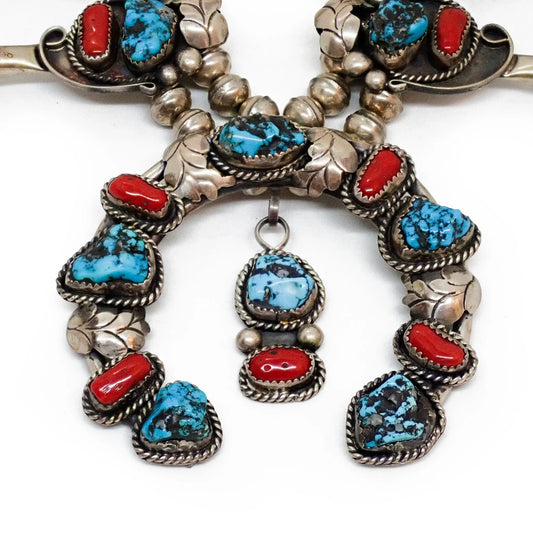
Substantial Native American Navajo Turquoise Nuggets & Coral Squash Blossom Sterling Silver Necklace SIGNED
Regular price $3,752.00 USDRegular priceUnit price per


Substantial Native American Navajo Turquoise Nuggets & Coral Squash Blossom Sterling Silver Necklace SIGNED
At a Glance:
Substantial Native American turquoise & coral squash blossom necklace
Stylistically consistent with Navajo bench work
Turquoise consistent with Kingman material
Bead strand with extender
Signed collector example with strong visual contrast and presenceNecklace Features:
- .925 sterling silver
- Turquoise nuggets in saturated shades of blue
- Red-orange coral accents
- Heavy-gauge sterling construction
- Bench-made beads strung on double-wire
- Hallmarked by the silversmith - artisan under active research
- Hook-and-eye closure
- Condition: Very Fine — see SCJ Vintage Condition Guide
Necklace Specifications:
- Wear scale: Statement matinee length per SCJ size guide, adjusted to opera length with the extender
- Largest turquoise: 5/8" x 1/2" (bezel to bezel)
- Naja: 2 1/2" x 2 7/8"
- Blossom length range: 1" - 1 1/8"
- Bead diameter: 8-9 mm
- Total length (including clasp): 20 3/8" (approx. 25 5/8" with the chain extender)
- Weight: 199.9 grams
ABOUT THIS PIECE:
The composition of this squash blossom necklace is built around contrast and proportion, with the naja as the focal point, carrying alternating turquoise nuggets and corals. The vivid blue nuggets and red coral accents are individually rope-framed and sit slightly proud of the silverwork, secure within their sawtooth bezels, giving the stones a strong architectural presence. The graduated blossoms repeat this pairing in measured intervals, creating a steady rhythm across the necklace and into the terminals.
Turquoise and coral form a color relationship long favored in Navajo jewelry, and the careful distribution of these hues, textures, and silver appliqués throughout the piece produces visual movement and harmony without crowding.
Construction details, including the blossom layout, bench-made beads, bezel work, and overall structure, align with traditional late-20th-century Navajo work. Although the necklace carries a maker’s mark that has not yet been definitively attributed to a specific artisan or tribe, it reflects the enduring design language of Navajo silversmithing.
Substantial in scale and visually commanding, this piece was designed to command attention.
ARTISAN NOTE:
The necklace bears a stamped maker’s mark consisting of a single stylized initial, which may read as "D," "J," or a combined form depending on orientation and strike. The hallmark indicates signed studio production rather than anonymous manufacture.
This specific mark does not currently correspond to documented entries in major published hallmark references or standard trade sources. Abbreviated or single-initial signatures of this type are not uncommon among Native American silversmiths working outside formal registry systems. Attribution, therefore, rests on hallmark presence and stylistic comparison rather than a confirmed artist identity.
Signed works of this scale and stone content generally represent individual studio output rather than contemporary mass production.
PERFECT FOR:
- Collectors of signed Native American jewelry
- Admirers of turquoise and coral designs
- Statement Southwestern dressing
- Layering with other necklaces or smaller bead strands
✨ Collectors Circle members receive a welcome offer on their first purchase.
$3,752.00
-
1950s - 1960s

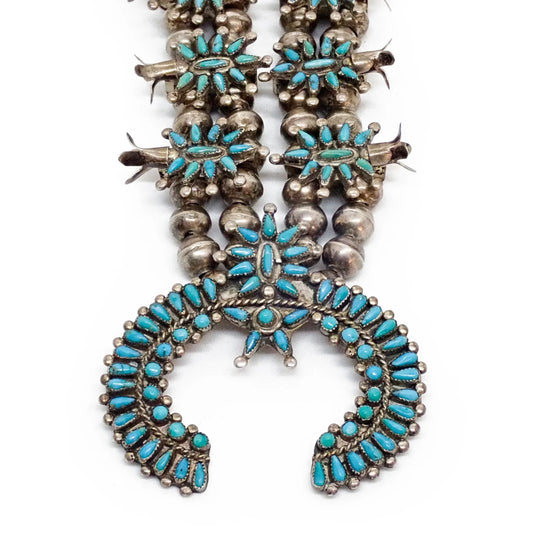
Zuni Turquoise Petit Point Cluster Squash Blossom Sterling Silver Necklace - Circa 1950-60s
Regular price $3,780.00 USDRegular priceUnit price per


Zuni Turquoise Petit Point Cluster Squash Blossom Sterling Silver Necklace - Circa 1950-60s
At a Glance:
Vintage Native American squash blossom necklace
Turquoise cluster work consistent with Zuni production
Hand-fabricated sterling silver construction
Unsigned post-Harvey Era production
Strong mid-century collector exampleNecklace Features:
- .925 sterling silver
- Turquoise in petit point, needlepoint, and snake-eyes (round cuts)
- Hand-fabricated beads strung on traditional foxtail chain
- Period wire hook-and-eye closure
- Circa 1950s - 1960s
- Condition: Very Fine — see SCJ Vintage Condition Guide
Necklace Specifications:
- Wear scale: moderate matinee presence per SCJ size guide, rendered in a refined mid-century scale
- Naja pendant: 2" x 2"
- Blossom length: approx. 1"
- Bead diameter: 7-8 mm
- Total length (including clasp): 25 7/8"
- Weight: 81.1 grams
ABOUT THIS PIECE:
This elaborate vintage squash blossom necklace presents the refined look collectors associate with mid-century Southwest silverwork. The four-petaled blossoms, restrained proportions, and balanced placement of stone and silver support a mid-century attribution. Masterfully cut into clusters of petit point, needlepoint, and round elements, the blue turquoise cabochons—with minimal matrix and subtle shade variation—create a dimensional, mosaic-like composition.
The necklace is consistent with the mature mid-century period of Zuni petit point and cluster jewelry. Handmade two-piece silver beads, carefully calibrated turquoise stones, and layered cluster construction are all characteristic of workshop production from that era, when fabrication remained fully handmade despite increasing refinement. Based on these construction features, the piece most likely dates to the 1950-60s. Matched cuts, even bezels, and the steady rhythm from the naja through each blossom unify the necklace while still highlighting each handmade component. The carefully assembled strand of beads on foxtail chain serves as a traditional backdrop for the stonework.
Each small, tightly fitted part of the ensemble required sustained lapidary and silverwork control, lending the piece a more delicate, labor-intensive character than the broader proportions that became more common later in the century.
PERFECT FOR:
- Collectors of vintage Zuni jewelry
- Admirers of traditional petit point and needlepoint work
- Those seeking squash blossom necklaces with balanced scale
- Southwestern and heritage-focused styling
- Pairing with other mid-century turquoise pieces
✨ Collectors Circle members receive a welcome offer on their first purchase.
$3,780.00
-
Pilot Mountain

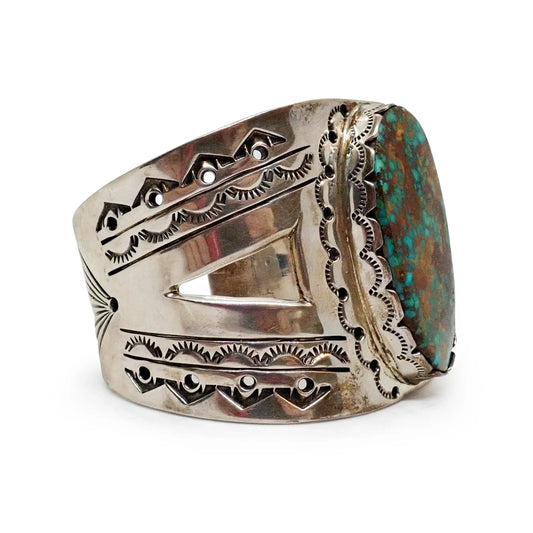
139-Gram Native American Navajo Pilot Mountain Turquoise Sterling Silver Cuff Bracelet by F. GUERRO
Regular price $1,850.00 USDRegular priceUnit price per


139-Gram Native American Navajo Pilot Mountain Turquoise Sterling Silver Cuff Bracelet by F. GUERRO
✨ Collectors Circle members receive a welcome offer on their first purchase.
At a Glance
Design: Native American signed wide turquoise cuff bracelet with heavy-gauge sterling construction, openwork sides, and crisp, measured silverwork
Stone: Large turquoise cabochon consistent with Pilot Mountain material
Color: Vivid blue-green turquoise with copper-brown matrix and strong natural variation
Accent: Hand-notched bezel, stampwork, chased linear cuts, small perforations, and triangular cut-out accents
Metal: .925 sterling silver
Artist: Signed Fred Guerro | Navajo silversmith Fred Guerro Senior
Era: Circa 1980s
Status: Signed heavy Navajo turquoise cuff bracelet
Condition: Very Fine — see SCJ Vintage Condition GuideSpecifications:
- Wear scale: large statement cuff with substantial wrist presence
- Turquoise: 1 3/4" x 1" (bezel to bezel)
- Face width: approx. 2"
- Inside length: 5 7/8"
- Gap: 1 3/8"
- Total inside circumference: 7 1/4" (L per SCJ size guide)
- Weight: 139.2 grams
Gallery Note:
This Fred Guerro cuff has the bold, disciplined presence collectors look for in late-20th-century Navajo silverwork. The large oval turquoise cabochon anchors the design with vivid blue-green color and broad copper-brown matrix, creating strong natural contrast without excess ornament.
The silverwork is measured and graphic. A hand-notched bezel frames the stone, while crisp stampwork, chased linear cuts, small perforations, and triangular openwork give the wide cuff movement, depth, and visual relief. Polished silver planes keep the composition clean, allowing the stone and construction to carry the piece.
From the side, the bracelet reveals its architecture: a high-profile stone setting, thick tapering shank, smooth interior, and substantial gauge. At 139.2 grams, it has the weight and presence of a serious statement cuff, while the openwork keeps the design from feeling visually heavy.
Built with strong turquoise character, confident bench work, and collector-scale weight, this cuff is a powerful example for those drawn to substantial Navajo bracelets with clarity, structure, and presence.
Hallmark & Maker Notes:
This bracelet is signed FRED GUERRO and carries a STERLING stamp. Reference and market examples associate this full Fred Guerro signature with Fred Guerro Sr., Navajo silversmith, distinguishing it from Fred Guerro Jr. examples that are commonly marked with a junior designation or FG Jr.
Fred Guerro Sr. was born on November 14, 1934, and lived a long life shaped by family, faith, work, and craft. Although he is widely identified as a Diné/Navajo, biographical references describe him as Chishi, Apache Clan, born for Áshiihí, Salt People Clan, reflecting Navajo clan identification rather than a separate primary tribal attribution. He spent much of his life in Alamo, with periods in To’hajiilee and Socorro, and passed away in Albuquerque on November 21, 2020.He spent most of his life in Alamo, with periods in To’hajiilee and Socorro. He passed away peacefully in Albuquerque on November 21, 2020, leaving behind a large family, a strong local memory, and a body of jewelry that continues to circulate among collectors.
By all accounts, Fred was the kind of man people remembered vividly. He was known for his humor, storytelling, teasing nature, and generosity. He opened his home to people who needed a place to stay, a place to recover, or simply a little steady ground. He was also deeply committed to his Christian faith, known for quoting scripture and encouraging others to know it well. That mix of warmth, conviction, and wit seems to have stayed with those who knew him best.
He was not only a silversmith; he also worked with his hands in other demanding trades, building houses, often in adobe, and taking on fence-building jobs that carried him across New Mexico. Family members remembered traveling with him for work and hunting, listening to his stories along the way. That kind of life matters when looking at his jewelry. His pieces do not feel detached from the world of labor, land, and daily use. They tend to have presence, weight, and a practical confidence that sits well within late-20th-century Navajo jewelry.
Reference sources and collector literature associate Fred Guerro’s work with stamp and file work, shadowbox construction, and set-stone jewelry. Reported hallmarks include F G, Fred G, and the previously mentioned "Fred Guerro" appearing in either stamped or inscribed form. Online examples of his signed jewelry also suggest a preference for substantial silver, bold stone presentation, and collector-scale forms, especially cuffs and other statement pieces. What makes his work appealing is that it does not need exaggerated language. The better pieces speak clearly on their own: strong silver, decisive stones, and a direct design sense that feels rooted rather than ornamental.
$1,850.00
-
Navajo Mosaic Inlay

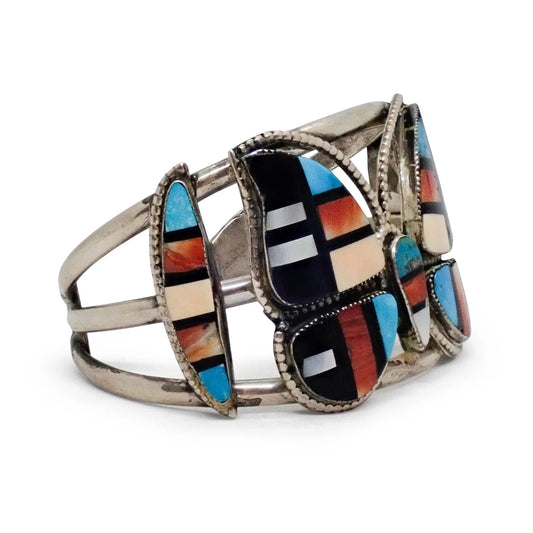
Navajo Multi-Stone Butterfly Inlay Sterling Silver Cuff Bracelet by M. BAHE
Regular price $782.00 USDRegular priceUnit price per


Navajo Multi-Stone Butterfly Inlay Sterling Silver Cuff Bracelet by M. BAHE
At a Glance:
Signed M BAHE sterling silver butterfly cuff attributed to Marie Bahe
Wide mosaic-inlaid butterfly centerpiece with matching side panels
Vivid color contrast framed by silver beadwork
Notable collector example of inlay work attributed to Marie BaheBracelet Features:
- .925 sterling silver
- Inlay work with turquoise, mother-of-pearl, coral, black and ivory-tone materials
- Butterfly motif and side panels framed by beaded wire appliqué
- Strong triple-split shank construction with clean interior finish
- Hallmarked by the silversmith
- Condition: Very Fine — see SCJ Vintage Condition Guide
Bracelet Specifications:
- Wear scale: medium statement cuff
- Centerpiece inlay: 1 1/2" x 2"
- Face width: 1 5/8"
- Inside length: 5 1/16"
- Gap: 1 1/4"
- Total inside circumference: 6 5/16" (S per SCJ size guide)
- Weight: 52.3 grams
ABOUT THIS PIECE:
This sterling silver cuff centers on a colorful butterfly inlaid mosaic set on a wide triple-split shank, an engaging piece that brings together a motif long appreciated in Native American culture with a Navajo interpretation of an inlay technique most closely associated with Zuni work. The matching side panels extend the mosaic design across the wrist, while beaded wire appliqués add texture and definition, complementing the piece's clean geometry.
The inlay combines turquoise, mother-of-pearl, coral, black stone (likely jet or onyx), and an ivory-tone material with soft orange hues, arranged in curved and angular segments. The layout is consistent with stone-on-stone inlay, a technique that requires precise cutting and fit. Smooth silver surfaces provide a restrained backdrop for the mosaic, allowing the color contrast and symmetry to carry the composition.
The triple-split construction gives the bracelet width while maintaining an open, balanced feel. The combination of careful stonework, measured silverwork, and clear structure contributes to the bracelet’s collector appeal.
Signed pieces attributed to Marie Bahe appear publicly more often in turquoise-set sterling forms than in mosaic inlay. Within that visible market record, this butterfly cuff stands out as a rarer example. Accordingly, the attribution to Marie Bahe rests solely on the maker’s mark and comparison with other pieces sold under her name, rather than on stylistic analysis.
ARTISAN NOTE:
Marie Bahe is identified in available hallmark references as a Navajo maker. Public biographical information appears limited, and no reliable published source has been found that directly connects her to the well-known silversmith Tom Bahe or to another documented Bahe jewelry lineage. However, the Bahe surname appears repeatedly in contexts related to Navajo jewelry, including exhibits, markets, and secondary sales platforms, suggesting that jewelry making is a recurring association among individuals who carry the name.
PERFECT FOR:
- Collectors of signed Native American jewelry
- Admirers of butterfly motifs and figural jewelry
- Anyone with an appreciation for inlay-focused jewelry
- Wearing as a statement Southwestern cuff with denim, black, ivory, or other clean solid tones
✨Collectors Circle members receive a welcome offer on their first purchase.
$782.00
-
Morenci Turquoise

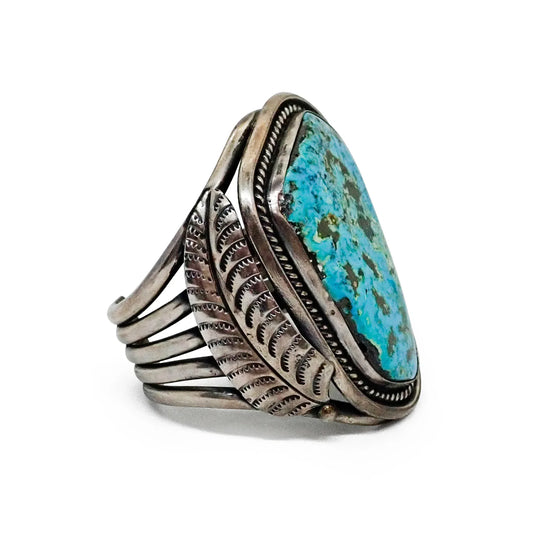
Heavy Sterling Silver Native American Navajo Morenci Turquoise Cuff Bracelet
Regular price $2,142.00 USDRegular priceUnit price per


Heavy Sterling Silver Native American Navajo Morenci Turquoise Cuff Bracelet
At a Glance:
Heavy sterling silver Navajo cuff with commanding turquoise centerpiece
Turquoise cabochon consistent with Morenci material
Stamped leaves & twisted wire frame add a strong traditional profile
Collector-oriented cuff built around a high-impact stoneBracelet Features:
- .925 sterling silver
- Saturated blue turquoise with dark brown matrix & pyrite
- Clean, heavy silver construction with bold split shank
- Smooth bezel framed with twisted wire
- Crisp crescent stamps applied to leaf motifs
- Unsigned hand-fabrication associated with Navajo silversmithing
- Condition: Very Fine — see SCJ Vintage Condition Guide
Bracelet Specifications:
- Wear scale: substantial presence with balanced proportions
- Turquoise: 2 3/16" x 1 3/8" (bezel to bezel)
- Face width: 2 5/8"
- Inside length: 5 1/4"
- Gap: 7/8”
- Total inside circumference: 6 1/8” (S per SCJ size guide)
- Weight: 105 grams
ABOUT THIS PIECE:
This substantial Native American cuff centers on a 98-carat turquoise cabochon associated with the Morenci mine based on its vivid blue color, matrix patterning, and pyrite-bearing character. Under that attribution, the material would have been mined before 1984 from one of the Southwest’s most storied and increasingly scarce turquoise sources.
The setting is bold without feeling crowded. A twisted wire bezel draws the eye inward, while a smooth outer border keeps the frame clean and in harmony with the cabochon's active patterning. Large leaf appliqués at the shoulders introduce a traditional Southwestern note and give the mount a more sculptural outline without competing with the stone.
Crafted from heavy-gauge silver, the cuff is built with an open split shank for a balanced profile on the wrist. At 105 grams, it has the kind of weight collectors expect from a serious vintage cuff (likely 1970s-1980s), pairing statement scale with controlled proportions.
PERFECT FOR:
- Collectors of American turquoise jewelry
- Anyone who appreciates turquoise with strong patterns and pyrite
- Curated bracelet groupings anchored by a central statement cuff
- Bench-fabricated Southwestern Native American silverwork
✨ Collectors Circle members receive a welcome offer on their first purchase.
$2,142.00
-
Indian Mountain

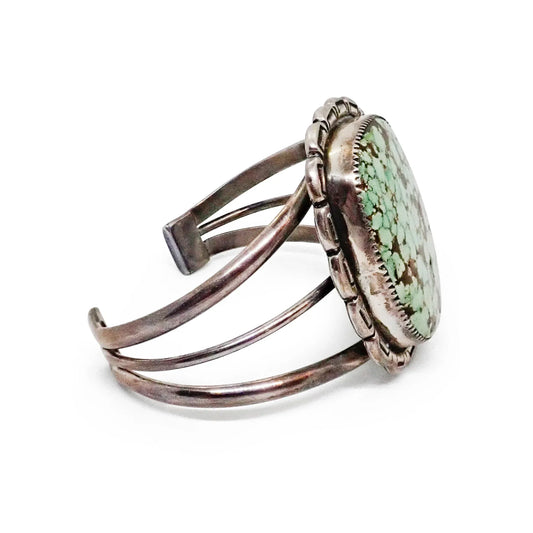
Navajo Spiderweb Indian Mountain Turquoise Sterling Silver Cuff Bracelet by G. DAMON
Regular price $655.00 USDRegular priceUnit price per


Navajo Spiderweb Indian Mountain Turquoise Sterling Silver Cuff Bracelet by G. DAMON
✨ Collectors Circle Members receive a welcome offer on their first purchase.
At a Glance
Design: Native American signed spiderweb turquoise cuff bracelet with clean three-tine Navajo construction and a stone-forward face
Stone: Spiderweb turquoise cabochon consistent with Indian Mountain
Color: Soft green and faint teal cells moving through dark brown host rock
Accent: Decorative segmented outer border
Metal: .925 sterling silver (unmarked)
Artist: Signed G | Gilbert Damon, Navajo silversmith
Era: Late 20th century (1970-80s)
Status: Signed Navajo spiderweb turquoise cuff bracelet
Condition: Very Fine — see SCJ Vintage Condition GuideSpecifications:
- Wear scale: visually bold cuff with a comfortable open fit and strong centerpiece presence
- Stone: 1 5/8" x 1 5/16" (bezel to bezel)
- Face width: 1 7/8"
- Inside length: 5 1/4"
- Gap: 1 1/4"
- Total inside circumference: 6 1/2"
- Weight: 60.8 grams
Gallery Note:
This signed Navajo cuff is defined by its turquoise: a richly webbed cabochon with teal-green cells moving through dark brown host rock. A complex and yet well-balanced matrix, with enough open green ground for the stone to read clearly and hold its presence on the wrist.
Damon’s silverwork keeps the setting clean and focused. A sawtooth bezel secures the cabochon and adds fine texture at the edge, while the stepped geometric border gives the face structure without crowding the stone. The three-tine shank is smooth, open, and deliberately understated, letting the turquoise remain the center of the design.
Reference and market examples more commonly associate Damon with chip inlay, making this large bezel-set spiderweb turquoise cuff a less common example of his documented range. For collectors, that contrast adds to its appeal — a signed Damon Gilbert in a stone-forward setting with restrained Navajo construction is a rare find.
Collector-minded without excess, this cuff earns its presence through the character of the stone and the clarity of the silverwork design.
Hallmark & Maker Notes:
This bracelet is signed with Gilbert Damon's hallmark — a stylized capital G, also associated in reference materials with the initials GD. His angular initial signature is reported to have been introduced around 1975, supporting the late-20th-century placement of this piece.
Damon was born June 20, 1930, in Fort Defiance, Arizona, into the Tsi'naajinii (Black Streak Wood People Clan), born for Tódich'ii'nii (Bitter Water Clan). He attended BIA Indian School in Fort Defiance, the Albuquerque Indian School, and Chilocco Indian School in Chilocco, Oklahoma.
He served in the Korean War — one of approximately 10,000 Native Americans who answered that call, many of them veterans of World War II as well, whose service and sacrifice remain an enduring part of this nation's history. He later spent 20 to 25 years employed with the Navajo Forest Products Industry in the Sawmill region in Arizona. He was a silversmith and family man who loved his children. He passed away on April 15, 2016, in Payson, Arizona.
Reference materials and market examples most commonly document Damon's work in chip inlay — crushed turquoise, coral, and related materials set into recessed silver channels, often with etched or oxidized geometric backgrounds. Authentic signed Damon pieces now enter the market through estate and secondary channels.
$655.00
-
Circa 1960-70s

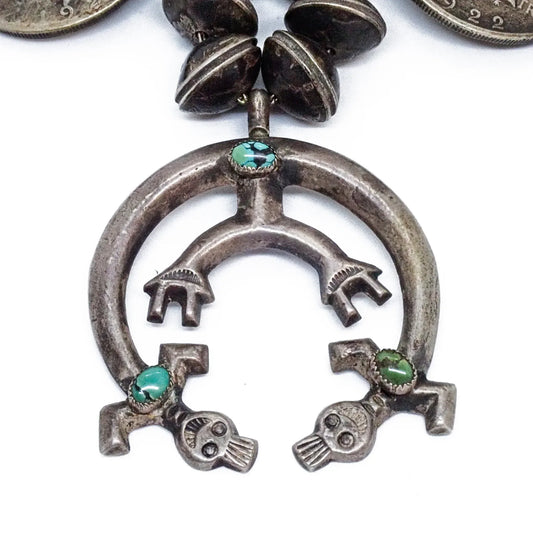
1960s-70s Native American Navajo Yei Naja & Peace Silver Dollar Coins Mercury Dime Bead Squash Blossom Necklace
Regular price $2,976.00 USDRegular priceUnit price per


1960s-70s Native American Navajo Yei Naja & Peace Silver Dollar Coins Mercury Dime Bead Squash Blossom Necklace
At a Glance:
Native American coin squash blossom necklace consistent with Navajo work
Beads formed from paired Mercury dimes
Peace silver dollar coin blossoms
Yei naja with turquoise cabochons
Heavy-gauge coin silver construction
A strong collector’s example of Navajo coin jewelryNecklace Features:
- U.S. silver coin construction (Mercury dimes & Peace dollars)
- Slightly domed Peace silver dollar coins (1922–1925)
- Coin beads assembled on chain, likely reflecting a later restringing
- Turquoise cabochons in blue-green tones
- Yei motif
- Cast naja consistent with sand-cast construction
- Traditional hook-and-eye closure
- Condition: Fine — see SCJ Vintage Condition Guide
Necklace Specifications:
- Wear scale: bold matinee length per SCJ size guide — falls at the bust line
- Naja pendant: 2 1/2" x 2 1/16"
- Coin blossom diameter: approx. 1 1/2"
- Bead diameter: approx. 16 mm
- Total length (including clasp): 24 3/4"
- Weight: 436.9 grams
ABOUT THIS PIECE:
This Native American squash blossom necklace reflects the coin-silver tradition long associated with Navajo silversmithing during the mid-twentieth century. Acquired as old pawn, the piece no longer retained its original pawn tag when it came into our possession. The style likely dates to the 1960s–1970s, based on construction, weight, and overall design character.
The strand is composed of paired Mercury dimes, domed and joined to create hollow silver beads that preserve visible traces of the original coin design. Formed and assembled by hand, these elements show natural variation in symmetry, reinforcing the work's individuality.
Suspended throughout the strand are slightly domed Peace silver dollar coins dating from the early to mid-1920s. Their scale interrupts the rhythm of the beadwork and recalls a coin-jewelry tradition in which historic American silver was reworked into substantial wearable form.
At the center hangs a cast Yei naja set with small turquoise cabochons. The pendant draws on Yei imagery associated with Navajo ceremonial traditions, adding a symbolic dimension to the composition.
With its considerable weight, historic coin materials, and a centerpiece rooted in heritage, this necklace stands as a strong collector’s example of Navajo coin jewelry—sculptural in presence and grounded in time-honored Southwestern silversmithing practices.
PERFECT FOR:
- Collectors of vintage Navajo coin jewelry
- Those seeking bold historic silver statement pieces
- Southwestern heritage collections
- Layering with turquoise necklaces and additional silver strands
✨ Collectors Circle members receive a welcome offer on their first purchase.
$2,976.00
- U.S. silver coin construction (Mercury dimes & Peace dollars)
-
Royston

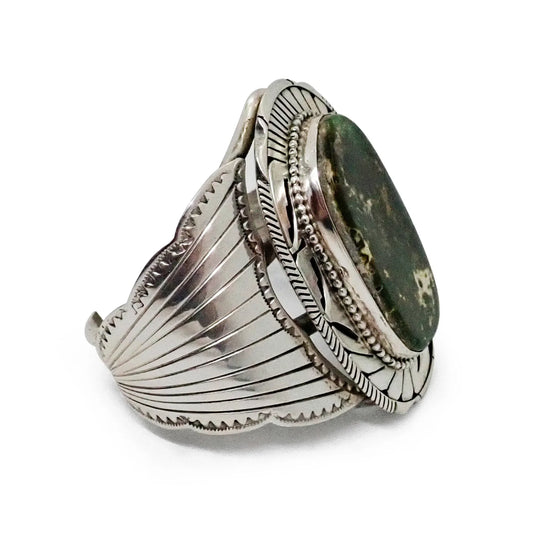
Solid Sterling Silver Native American Navajo Dark Green Royston Turquoise Cuff Bracelet by E. KEE
Regular price $1,488.00 USDRegular priceUnit price per


Solid Sterling Silver Native American Navajo Dark Green Royston Turquoise Cuff Bracelet by E. KEE
At a Glance:
Heavy 114 grams Navajo turquoise & sterling cuff signed Elouise Kee
Dark green turquoise consistent with Royston district material
Kee's signature negative space design
Collector example with a unique single stone design & disciplined profileBracelet Features:
- .925 sterling silver
- Deep green cabochon with mossy tones and pale tan matrix
- Cutout shadowbox face
- Beadwire framing, chasing, and stampwork
- Wide tapered cuff in heavy-gauge sterling silver
- Hallmarked by the silversmith
- Condition: Very Fine — see SCJ Vintage Condition Guide
Bracelet Specifications:
- Wear scale: substantial weight with balanced proportions
- Turquoise: 1 13/16" x 1 1/8" (bezel to bezel)
- Face width: 2 1/2"
- Inside length: 5 1/2"
- Gap: 1 5/16"
- Total inside circumference: 6 13/16" (M per SCJ size guide)
- Weight: 114.8 grams
ABOUT THIS PIECE:
This commanding Native American cuff centers on a dark green turquoise cabochon with forest and mossy tones surrounding islands of pale tan matrix. The color palette is deeper and moodier than the brighter blue and green material more often associated with the Royston district, giving the stone a different kind of presence — richer, earthier, and more grounded. Its size and saturated body color make it a very strong visual anchor.
Around the stone, the design is organized with precision. A smooth bezel, framed by beadwire, defines the cabochon, while the cutout shadowbox gives the piece an open aesthetic and creates contrast between the shiny silver planes and the recessed negative space. The cutout work— an element often associated with Elouise Kee’s signature style — and the radiating chased lines and stampwork guide the eye outward from the center, drawing attention to the maker's skilled silverwork.
The shank is built from heavy-gauge sterling silver and adorned with oversized flanking forms that give the mount a structured, almost architectural rhythm without overwhelming the stone. At 114.8 grams, it has the substance prized by many collectors of vintage Native work, with a profile that remains composed without excess.
ARTISAN NOTE:
Available reference material identifies Elouise Kee as a Navajo silversmith associated with Gallup, New Mexico, and as married to Eugene Belone, whom she is described as having taught the craft of jewelry making and silversmithing. Jewelry attributed to Kee is admired for refined sterling silverwork, crisp detail, and carefully selected turquoise, including material represented as Kingman and Royston. Her work reflects a confident design voice grounded in traditional Navajo silversmithing, balancing strong form with measured ornament. Family information published in Gerald Gene Belone’s January 2025 obituary names Elouise Kee and Gene Belone as his parents, confirming that she was living at least as of early 2025. The obituary also notes that Gerald was preceded in death by his brother, Dewayne Belone, suggesting additional family loss, though such details should be treated with care beyond the obituary itself. While we have not located a definitive public source confirming her current production status, her jewelry continues to appear in recent market offerings, reflecting ongoing visibility and collector interest.
PERFECT FOR:
- Collectors of signed Navajo cuffs
- Turquoise enthusiasts drawn to green cabochons
- Collections focused on statement silverwork
- Elevated Western attire, denim, black, and earth-toned wardrobes
✨ Collectors Circle members receive a welcome offer on their first purchase.
$1,488.00
-
Rare Green Matched Set

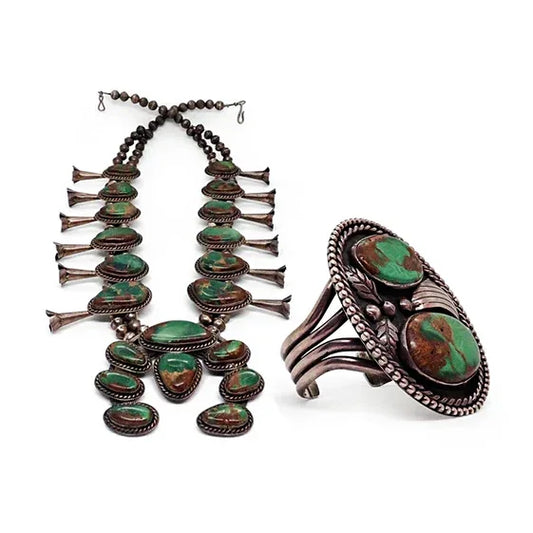
1970s Emerald Green Turquoise Squash Blossom Sterling Silver Necklace & Bracelet Set by Navajo Artist D. HARRISON
Regular price $5,315.00 USDRegular priceUnit price per


1970s Emerald Green Turquoise Squash Blossom Sterling Silver Necklace & Bracelet Set by Navajo Artist D. HARRISON
✨ Collectors Circle members receive a welcome offer
At a Glance:
Design: Native American squash blossom necklace and matching two-stone cuff bracelet set with large-scale silverwork, repeating flared blossom forms, and an eight-stone naja
Stone: Turquoise cabochons consistent with King’s Manassa material
Color: Teal, light green, and emerald green turquoise with golden-brown host rock
Accent: Chased wing, leaf, and silver drop details on the cuff
Metal: .925 sterling silver
Artist: Signed DH | Douglas Harrison, Navajo silversmith
Era: Circa 1970s
Status: Signed vintage Navajo squash blossom and cuff set from a finished studio period, conceived as a matching ensemble
Condition: Excellent — see SCJ Vintage Condition GuideNecklace Specifications:
- Wear scale: substantial, matinee length per SCJ size guide — rests below the bust line on most wearers
- Largest stone: 11/16" x 1 1/2" (bezel to bezel)
- Naja pendant: 3" x 3 5/8"
- Blossom length range: 1 1/8" - 2 1/2"
- Bead form: traditional seamed bench-made Navajo beads strung on wire
- Bead diameter: 8-9 mm
- Total length (including clasp): 28"
- Clasp: hook and eye
- Weight: 299.4 grams
Bracelet Specifications:
- Wear scale: statement cuff presence with broad face and balanced stone scale
- Largest turquoise: 1" x 1 1/2" (bezel to bezel)
- Face width: 2 7/8"
- Inside length: 5 3/16"
- Gap: 1"
- Total inside circumference: 6 3/16” (S per SCJ size guide)
- Weight: 85.6 grams
Gallery Note:
This vintage Navajo squash blossom necklace and matching cuff set has a bold, commanding presence. Built in substantial scale, the ensemble is defined by heavy-gauge silverwork, hand-fabricated and hand-assembled elements, square-cut flared blossoms, bench-made beads, and a powerful eight-stone naja that anchors the necklace with unmistakable visual weight.
The turquoise shows soft emerald, teal, and blue-green notes broken by warm golden-brown host rock. Its color and matrix are consistent with King’s Manassa material, though comparable material can also be found in Nevada. As with most historic turquoise, the mine identification is observational, and the precise origin is confirmed only with sourcing documentation or laboratory analysis.
The cuff carries the necklace’s palette into a dramatic wrist form, pairing two cabochons with applied silver details that connect the pieces without making them feel overly matched. Worn together, they create a commanding signed Navajo statement for collectors drawn to generous turquoise, substantial handmade construction, and high-impact Western heritage jewelry.
Hallmark & Maker Notes:
Jewelry bearing the DH hallmark is associated in the vintage market with Navajo silversmith Douglas Harrison. Signed works surface primarily through estate and vintage circulation and are recognized for substantial gauge, generous turquoise use, and strong late twentieth-century presence.
As with many working silversmiths of the period, formal biographical documentation can be limited. This attribution rests on hallmark consistency and comparison across documented examples. Existing pieces represent completed studio production rather than an active contemporary line, making matched necklace-and-cuff sets notably less common than individual works.
✨ Collector inquiries are welcome. SCJ is open to thoughtful questions, documented observations, and new information that deepens the story of a piece. With permission, selected comments from our Members may be featured in our upcoming Collectors Circle Insights publications.
$5,315.00


