


-
1950s

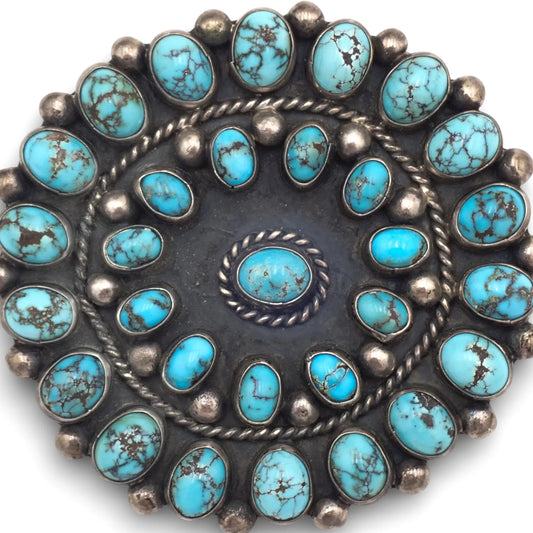
1950s Native American Navajo Persian Turquoise Rosette Cluster Sterling Pin Brooch by TOBE TURPEN
Regular price $1,115.00 USDRegular priceUnit price per


1950s Native American Navajo Persian Turquoise Rosette Cluster Sterling Pin Brooch by TOBE TURPEN
✨ Collectors Circle members receive a welcome offer
At a Glance:
Design: Mid-Century trading post Navajo turquoise cluster sterling pin brooch with hand-laid rosette construction
Stone: Thirty high-domed turquoise cabochons consistent with Persian material
Color: Fine spiderweb matrix with natural variation, spread across a cluster that ranges from sky to vivid blues
Accent: Handmade and hand-assembled rope details with silver shots
Metal: .925 sterling silver (unmarked)
Attribution: Engraved TT | Tobe Turpen trading post
Era: Circa 1950s, postwar trading-post period
Status: Shop-marked turquoise cluster, unmarked silver pin brooch associated with Navajo work (not artist-signed)
Condition: Excellent — see SCJ Vintage Condition GuideSpecifications:
- Wear scale: medium-large statement pin best suited for light denim and similar jackets, mantas, or scarves — structured fabrics with enough support for its weight
- Center turquoise: 1/4" x 5/16" (bezel to bezel)
- Diameter: 2 3/8"
- Weight: 41 grams — substantial for a brooch
Gallery Note:
This turquoise cluster brooch carries the quiet authority collectors look for in trading-post jewelry: a hand-built turquoise cluster, a substantial silver backplate, original pin assembly, and a maker's mark associated with a historical Gallup trading post.
The bezels were hand-formed, the cabochons were hand-assembled, and the stones were individually placed in concentric rings with a clear center point. The layout achieves the kind of symmetry only a human hand can produce — balanced in overall composition, with natural variations in spacing, dome height, stone shape, and accent alignment that come from working by eye rather than by template. That hand-laid quality gives the brooch a sense of order without stiffness — a balanced cluster with the natural rhythm of the era's bench-made work.
The matched turquoise brings brightness and depth to the composition. Color moves from a softer sky-blue to more saturated shades, with a fine spiderweb matrix visible throughout the cluster. A longtime former owner of a Southwestern trading post, familiar with vintage turquoise, identified the material as likely Persian turquoise based on dome style, character, and period context. The attribution was subsequently confirmed by SCJ's appraiser, and it's therefore presented as an informed visual assessment by two industry professionals, rather than a laboratory origin analysis. While Iranian turquoise is most famous for a clear robin's egg appearance, documented examples show spiderweb Persian turquoise developed a following of its own in the U.S. According to reference material, the import of Persian turquoise began in the early 1890s and continued until 1979, when the U.S. implemented the first major wave of trade sanctions, cutting off most direct imports from Iran.
The silverwork supports the cluster without distracting from it. The heavier backplate gives the brooch substance, while handmade rope details and silver balls add texture and dimension between the stones. The original pin assembly and unmarked silver content are consistent with older Native American jewelry made for trading-post circulation, where shop marks, purity stamps, and artist signatures were not always applied with modern consistency.
Hallmark & Maker Notes:
This brooch is stamped TT on the reverse — a mark documented in reference sources as the retail shop control mark of Tobe Turpen’s Trading Post in Gallup, New Mexico. It is a shop mark, not an artist’s signature, and does not identify the individual maker.
That distinction matters. A related mark — a tilde, sometimes accompanied by TT — is associated with Fred Thompson (1922–2002), a Diné silversmith whose career began at age 15 working for Turpen and whose jewelry remained closely tied to the post through the 1950s. This brooch carries the plain TT mark, without the tilde, placing it with the shop’s control mark rather than Thompson’s personal hallmark.
The Turpen family story reaches back to the early 1900s, when Tobe Turpen Sr. came west from Texas and entered the trading business through family connections in Arizona. He worked in reservation trade settings, learned the Navajo language at Blue Canyon, moved through the Gallup network, and in 1939 opened his own post in a building purchased from J. L. Hubbell on North Third Street.
After World War II, Tobe Turpen Jr. joined his father in the business and later took ownership in the mid-1950s. As highway construction and changing travel routes reshaped Gallup, the post eventually relocated from North Third Street to South Second Street. During the boom years of Native American jewelry collecting, Tobe Turpen’s supplied retailers far beyond Gallup and built a strong reputation among dealers for quality material, active trade relationships, and steady jewelry placement.
The reverse of this brooch adds another layer to that working history. In addition to the TT shop mark, the back shows a scratched notation that appears to read “MIOE” or similar, with a small cross mark below it, along with remnants of two old paper tags. These are consistent with practical shop, pawn, inventory, or resale notations — the kind of back-of-piece marks used as jewelry moved through retail and trading channels. They are not maker’s marks and do not change the attribution.
This is where the broader story comes into focus. Rail and highway travel helped introduce Native American and Southwestern silverwork to a wider public, but Gallup posts helped sustain the production networks behind it. They connected makers, materials, buyers, wholesalers, and retailers at the point where jewelry was still being shaped by hand, stone by stone and setting by setting.
For collectors, that matters because jewelry associated with mid-century trading-post production often retains the character of individual bench work rather than strict duplication from a single master pattern. This brooch reflects that moment: demand was expanding, the market was reaching farther, but fabrication still depended on the maker’s eye and hand. SCJ presents the piece as a Tobe Turpen-associated, Navajo-made turquoise cluster brooch from the postwar Gallup trading-post period, with no individual maker assigned.
✨ Collector inquiries are welcome. SCJ is open to thoughtful questions, documented observations, and new information that deepens the story of a piece. With permission, selected comments from our Members may be featured in our upcoming Collectors Circle Insights publications.
$1,115.00
-
Late 20th Century

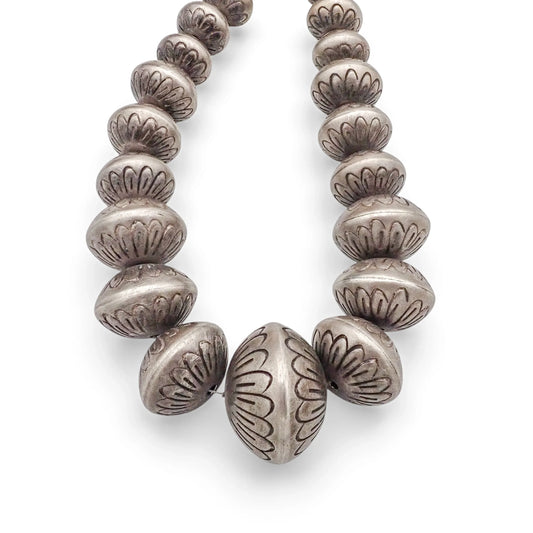
Late 20th Century Native American Hand-Chased Sterling Silver Graduated Navajo Pearls Bead Necklace
Regular price $2,475.00 USDRegular priceUnit price per


Late 20th Century Native American Hand-Chased Sterling Silver Graduated Navajo Pearls Bead Necklace
✨ Collectors Circle Members receive a welcome offer
At a Glance:
Design: Native American graduated Navajo pearl necklace with oversized, hollow sterling saucer beads, and classic chased petal decoration
Stone: None
Color: Satin sterling silver finish with moderate patina
Accent: Fluted terminal beads, fitted spacers below the cones, and hand-chased decoration
Metal: .925 sterling silver (unmarked)
Attribution: Consistent with Navajo work
Era: Late 20th century
Status: Unsigned and unstamped vintage sterling Navajo pearl necklace with period-appropriate construction
Condition: Very Fine — see SCJ Vintage Condition GuideSpecifications:
- Wear scale: opera length — falls at or below the bust on most wearers
- Center bead size: 25 mm, approx. 1"
- Graduated bead range: 10–25 mm, strung on vinyl-coated wire core
- Total length: 30 1/2" (including clasp)
- Clasp: traditional wire hook-and-eye clasp
- Weight: 161.8 grams — substantial for a strand of this length
Gallery Note:
This Native American Navajo pearl necklace follows the long, graduated strand format that became especially favored in the late twentieth century, when silversmiths emphasized balanced proportions and substantial silver weight. The strand builds visually into a single oversized center bead, then tapers evenly toward the terminals so the necklace reads as one continuous line rather than a sequence of parts.
Each piece was formed from sterling sheet, soldered into a hollow structure, and finished into a flattened lentil profile with seams that nearly disappear into the curvature. Decoration appears as petal-like chased motifs that travel from the seam toward the drill hole, following the contour of the bead. The pattern adds gentle movement while preserving the visual continuity of the strand.
Silver bead necklaces became part of Navajo metalwork in the late nineteenth century as silversmithing techniques spread throughout the Southwest. By the early twentieth century, hollow sterling spheres were commonly worn both as adornment and as portable silver wealth.
Today, substantial strands like this remain a clear expression of Navajo silverwork—durable, elegant, and timeless.
Hallmark & Maker Notes:
This necklace is unsigned. The Navajo attribution is based on the graduated, hollow bead construction, chased petal decoration, fluted terminal beads, hook-and-eye, and overall late 20th-century Navajo pearl format.
✨ Collector inquiries are welcome. SCJ is open to thoughtful questions, documented observations, and new information that deepens the story of a piece. With permission, selected comments from our Members may be featured in our upcoming Collectors Circle Insights publications.
$2,475.00
-
Leo Yazzie

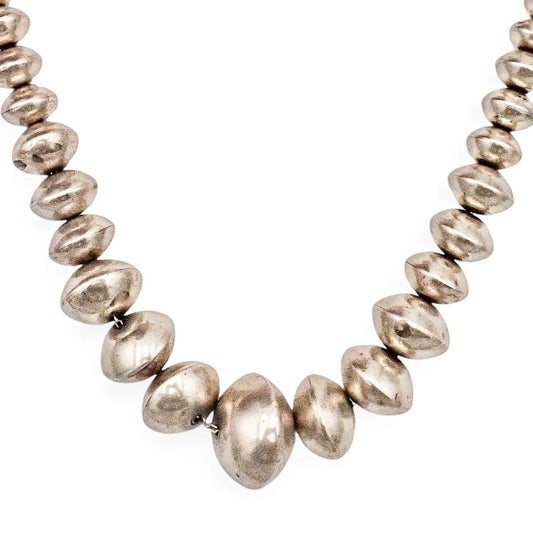
Native American Navajo Smooth Sterling Silver Graduated Navajo Pearls Bead Necklace by L. YAZZIE
Regular price $1,437.00 USDRegular priceUnit price per


Native American Navajo Smooth Sterling Silver Graduated Navajo Pearls Bead Necklace by L. YAZZIE
✨ Collectors Circle members receive a welcome offer
At a Glance:
Design: Native American graduated Navajo pearl necklace with smooth hollow sterling silver saucer beads
Stone: None
Color: Bright satin sterling silver with minor scattered oxidation
Accent: None
Metal: .925 sterling silver
Artist: Signed "LY" | Leo Yazzie, Navajo silversmith
Era: Late 20th century
Status: Signed vintage Navajo pearl necklace with classic graduated beadwork and hand-fabricated construction
Condition: Fine — see SCJ Vintage Condition GuideSpecifications:
- Wear scale: classic matinee length, falling between collarbone and bust on most wearers
- Center bead diameter: 25 mm (approx. 1")
- Graduated bead range: 11-25 mm, strung on link chain
- Total length: 22 3/8" (including clasp)
- Clasp: traditional wire hook and eye
- Weight: 100.1 grams
Gallery Note:
Rather than relying on surface ornament, this necklace demonstrates the quiet confidence of classic Navajo beadwork, where proportion, silhouette, and craftsmanship define the design. The smoothly graduated strand builds naturally toward an oversized 25 mm center bead before tapering evenly toward the clasp, creating balanced visual weight and an elegant drape along the neckline. Individually linked hollow beads articulate freely, allowing the strand to move comfortably while maintaining its sculptural profile.
Each bead was hand-fabricated from sterling silver sheet, soldered into a hollow form, then finished with smooth surfaces that place the emphasis on contour rather than decoration. Subtle variations among the beads reflect the individuality expected of bench-made work, giving the necklace a character distinct from machine-perfect production while preserving the harmony of the overall composition.
Silver bead necklaces became part of Navajo silversmithing during the late nineteenth century as metalworking traditions evolved throughout the Southwest. By the early twentieth century, hollow sterling beads had become enduring symbols of both personal adornment and portable silver wealth. Their enduring appeal continues to rest in the balance between refined simplicity, skilled fabrication, and timeless versatility.
Hallmark & Maker Notes:
The necklace is signed "LY" on the silver tag at the closure. This maker's mark is associated with Leo Yazzie, a Navajo silversmith from the Black Mesa region of Arizona who later worked in Flagstaff. His introduction to silversmithing began while attending Northern Arizona University, where a metalsmithing elective redirected his studies toward jewelry. By the early 1980s, he was working as a full-time silversmith, a career that continued for more than three decades before his retirement.
Yazzie's work reflects influences rooted in home and family. He has cited the storm-pattern geometry found in his mother’s and grandmother’s Navajo weaving, along with Navajo spiritual teachings, as formative sources. Rather than relying on heavy surface ornament, his designs tend to favor measured spacing and deliberate stone placement, where the pattern is created by the stones themselves. When decorative elements such as stamping and chasing are utilized, they are applied with restraint and precision, supporting the form rather than dominating it.
During his active years, Yazzie worked primarily in sterling silver, sometimes incorporating gold. He preferred fine turquoise alongside coral, sugilite, lapis, and opal. Precisely fitted inlay and controlled settings became consistent features of his mature pieces, emphasizing balance between material and form.
Leo Yazzie's pieces have been widely shown through regional and national galleries, earning juried recognition and developing a strong collector following. With his retirement, signed examples now represent completed studio work from his late 20th- and early 21st-century production period.
✨ Collector inquiries are welcome. SCJ is open to thoughtful questions, documented observations, and new information that deepens the story of a piece. With permission, selected comments from our Members may be featured in our upcoming Collectors Circle Insights publications.
$1,437.00
-
Presley & Della Curley

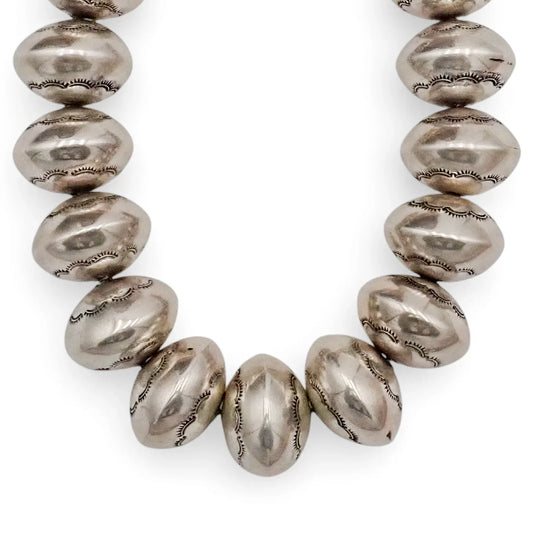
Native American Statement Hand-Stamped Sterling Silver Navajo Pearls Choker 1" Bead Necklace by P. & D. CURLEY
Regular price $3,278.00 USDRegular priceUnit price per


Native American Statement Hand-Stamped Sterling Silver Navajo Pearls Choker 1" Bead Necklace by P. & D. CURLEY
✨ Collectors Circle Members receive a welcome offer
At a Glance:
Design: Native American choker-length Navajo pearl necklace with oversized hand-fabricated sterling silver beads
Stone: None
Color: Lustrous sterling silver with hand-stamped oxidized impressions
Accent: Uniform 1" bead construction with restrained mid-section stampwork and substantial hook clasp
Metal: .925 sterling silver
Artist: Signed PC | Presley and Della Curley, Navajo silversmiths
Era: Late 20th century
Status: Signed vintage Navajo pearl collector necklace
Condition: Very Fine — see SCJ Vintage Condition GuideSpecifications:
- Wear scale: bold choker-length necklace — rests close to the base of the neck on most wearers
- Bead size: 25–26 mm, strung on traditional foxtail chain
- Length (including clasp): 16 7/8" (model shown has a 12 1/2" neck, and average neck sizes may benefit from a 3 – 4" extender for a more relaxed drape)
- Clasp: substantial handmade hook clasp
- Weight: 153.5 grams
Gallery Note:
This strand of Native American-made beads presents a dramatic row of unusually large silver beads defined less by ornament than by proportion — a measured sequence of substantial, hand-formed elements assembled into a collar-length arrangement. Each bead was individually shaped, joined, and stamped in an understated fashion before being strung together, allowing the visual rhythm to arise from form and spacing rather than dense decoration.
The hallmark stamped on the terminal bead identifies the work of Della and Presley Curley, whose jewelry is recognized across documented examples for consistent construction and finishing. Even in late-twentieth-century work, producing matched beads of this scale required careful forming, soldering, and individual stamping — a demanding process that highlights the Curleys’ superior artistry. These Navajo pearls are a testament to the harmonious, coordinated bench practice typical of their partnership, where each artisan's vision reads as a continuous form.
Silver bead necklaces developed from early Diné silversmithing in the late nineteenth century, following the adoption of metalworking fabrication learned over the years through contact with Spanish and Mexican smiths. By the early twentieth century, hollow beads had become a distinctive element of Navajo adornment, valued both for their aesthetics and as portable wealth. These pearls demonstrate adherence to methods passed down through generations and the inherent quality of traditional Navajo silverwork.
Hallmark & Maker's Notes:
Della and Presley Curley are a Navajo husband-and-wife silversmith team active from the 1970s through the 1990s, signing their jewelry with a shared “PC” hallmark. Their recorded working period follows the waning of the traditional trading-post system, when many Diné artisans carried on time-honored silversmithing methods within independent family workshops, where knowledge passed bench to bench rather than through formal studios.
As with many makers of this generation, their history is preserved primarily in their creations rather than in print. Attribution rests in the metal — the hallmark, steady hand fabrication, and crisp embellishments — all elements associated with the growing preference for artisan recognition and robust, well-crafted Navajo silverwork in the late twentieth century.
The shared mark reflects a household bench practice common in Navajo jewelry-making, where collaboration often mattered just as much as individual authorship. With limited written record, understanding their work has developed through comparison of authenticated examples and the recurring characteristics recognized by collectors over time. Although later activity has not been formally documented, their work is placed within the Navajo silverwork revival and the decades that followed, when reclaiming historic forms in jewelry evolved from renewed interest into established tradition — a quiet lineage living not in catalogs but with those who recognize the heritage reflected in each piece.
✨ Collector inquiries are welcome. SCJ is open to thoughtful questions, documented observations, and new information that deepens the story of a piece. With permission, selected comments from our Members may be featured in our upcoming Collectors Circle Insights publications.
$3,278.00
-
Royston

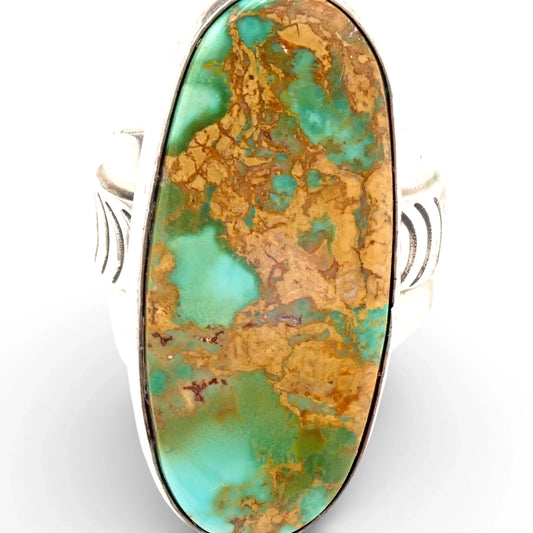
Royston Turquoise Sterling Silver Chased Adjustable Ring by Navajo Artist R. MAYES
Regular price $335.00 USDRegular priceUnit price per


Royston Turquoise Sterling Silver Chased Adjustable Ring by Navajo Artist R. MAYES
✨ Collectors Circle Members receive a welcome offer
At a Glance:
Design: Native American stone-forward ring with elongated vertical turquoise cabochon
Stone: Turquoise consistent with Royston material
Color: Vivid blue-green with warm golden matrix
Accent: Chased crescent shoulder band applied over the shank
Metal: .925 sterling silver
Artist: Signed R. MAYES | Robert Mayes, Navajo silversmith
Era: Circa late 1980s
Status: Signed vintage period piece
Condition: Fine — see SCJ Vintage Condition GuideSpecifications:
- Wear scale: medium-large with high visual impact
- Stone: 1 1/8" x 1/2" (bezel to bezel)
- Face width: 1/2"
- Face length: 1 1/8"
- Ring size: 7.25 (adjustable to approx. full size up)
- Weight: 12.9 grams
Gallery Note:
This Navajo ring is centered on a vivid blue-green turquoise cabochon with warm golden matrix and strong visual movement. The stone’s color range, matrix patterning, and organic depth are consistent with Royston district material, giving the ring a vibrant, stone-forward presence.
The silverwork is intentionally restrained, with a slim bezel that allows the turquoise to command the composition. Chased crescent details along the shoulders introduce subtle movement while keeping the overall design clean, balanced, and wearable.
The adjustable shank carries quiet structural strength, remaining wider where it meets the face and tapering at the center for comfort. Signed R. MAYES and attributed to Navajo silversmith Robert Mayes, this late-1980s ring reflects a period of Southwestern studio jewelry where bold turquoise cabochons and minimal silverwork were often paired for maximum visual impact.
Hallmark & Maker Notes:
Robert Mayes is referenced in the secondary market as a Navajo silversmith associated with sterling silver jewelry signed R. MAYES or RM. Public biographical information appears limited, so this attribution is based on the hallmark, comparable market references, and the construction of the piece. His known market examples often place emphasis on the stone, pairing turquoise or other cabochons with restrained sterling silverwork.
✨ Collector inquiries are welcome. SCJ is open to thoughtful questions, documented observations, and new information that deepens the story of a piece. With permission, selected comments from our Members may be featured in our upcoming Collectors Circle Insights publications.
$335.00
-
1950s Taxco

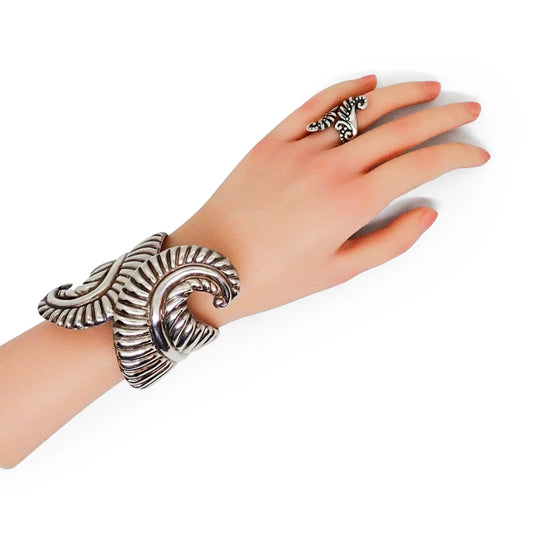
1950s TAXCO Sterling Silver Fern Motif Hinged Clamper Bracelet & Ring Set
Regular price $435.00 USDRegular priceUnit price per


1950s TAXCO Sterling Silver Fern Motif Hinged Clamper Bracelet & Ring Set
✨Collectors Circle members receive a welcome offer
At a Glance:
Design: Mid-century Taxco sterling silver bracelet and ring set with sculptural botanical fern/frond motifs, a hinged clamper bracelet, and coordinating open-front ring
Metal: .925 sterling silver
Artist: Taxco silversmiths | bracelet maker’s mark partially faded and under research; ring hallmark partially struck
Era: Circa 1950s
Status: Vintage Taxco set with partially faded bracelet maker’s mark and partially struck ring hallmark; ring coordinates with the bracelet but is not an exact match
Condition: Fine — see SCJ Vintage Condition GuideBracelet Specifications:
- Wear scale: wide sculptural presence without excess weight
- Terminal face width: 2 1/2"
- Inside length: 7 1/4"
- Total inside circumference: 6 3/4" - 7 1/2", adjustable via hinge closure & overlapping terminals (M-L per SCJ size guide)
- Weight: 55.7 grams
Ring Specifications:
- Wear scale: dramatic coordinating botanical motif & design
- Face width: 1.25"
- Size: 9 with slightly adjustable open front
- Weight: 5.9 grams
Gallery Note:
This vintage Taxco bracelet and ring set brings together bold mid-century silverwork with a sculptural botanical fern motif. The bracelet has a strong hinged clamper form, with overlapping terminals and high-relief frond detailing that gives the piece movement, dimension, and a confident wrist presence.
The coordinating ring echoes the same fern-inspired silver vocabulary while remaining a complementary companion rather than an exact match. Its open-front construction offers slight flexibility, making the set feel collected and organic rather than factory-paired.
The brighter sterling finish highlights the raised botanical contours and curled silverwork, giving the set a polished, wearable presence while preserving the character expected of fine vintage Taxco silver.
Hallmark & Maker Notes:
The interior of the bracelet bears a partially faded circular Taxco maker’s mark. The outer ring appears to read STERLING 925 / TAXCO MEX, with overlapping central initials that may read LGP or LGPP. Research points to P. Lopez G. as a possible lead among documented Taxco silversmiths, but the stamp is not clear enough to confirm a named maker at this time.
The coordinating ring also bears a partially struck hallmark consistent with mid-century Taxco marking conventions. The stamp appears to have been partially cut off during production, leaving too little identifying detail to research or attribute the ring to a specific silversmith with confidence at this time.
Together, the marks, sterling content, hinged clamper construction, open-front ring form, and sculptural repoussé work support a mid-century Taxco attribution, circa 1950s. The maker remains under active research.
✨ Collector inquiries are welcome. SCJ is open to thoughtful questions, documented observations, and new information that deepens the story of a piece. With permission, selected comments from our Members may be featured in our upcoming Collectors Circle Insights publications.
$435.00
-
Statement

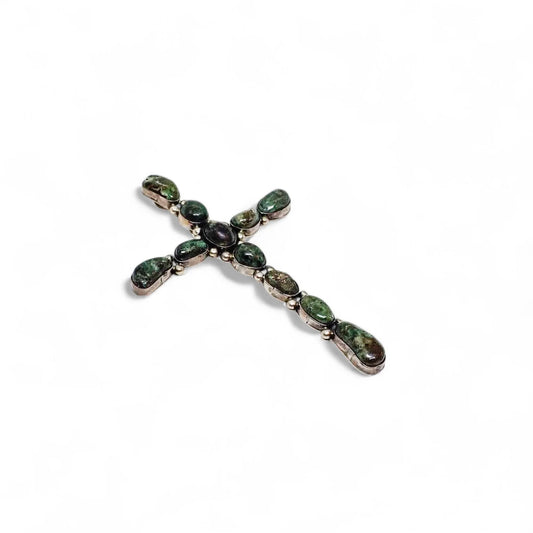
Extra-Large Navajo Green Turquoise Cluster Sterling Silver Cross Pendant by E. Anderson
Regular price $655.00 USDRegular priceUnit price per


Extra-Large Navajo Green Turquoise Cluster Sterling Silver Cross Pendant by E. Anderson
✨ Collectors Circle members receive a welcome offer
At a Glance:
Design: Native American extra-large turquoise cluster cross pendant with balanced cluster placement and elongated cross form
Stone: Eleven green turquoise cabochons consistent with Nevada material
Color: Green, smoky teal, olive, and blue-green tones with black, reddish-brown, and yellow matrix
Accent: Silver beads at the stone settings
Metal: .925 sterling silver
Artist: Signed E. A. | Evelyn Anderson, Navajo silversmith
Era: Late 20th century
Status: Signed vintage Native American jewelry piece
Condition: Very Fine — see SCJ Vintage Condition GuideSpecifications:
- Wear scale: extra-large statement pendant — covers upper chest area when worn with choker-length Navajo pearls (not included)
- Largest stone: 7/8" x 1/2" (bezel to bezel)
- Width: 3"
- Length: 4 5/8"
- Bail: open shepherd's hook designed for direct attachment to heavy-gauge chains, such as foxtail-strung Navajo pearls.
- Weight: 29.9 grams
Gallery Note:
This extra-large Navajo turquoise cross pendant is centered on eleven green cabochons arranged across a substantial sterling silver framework. The stones carry a deep, earthy green palette with scattered blue accents, while black, reddish-brown, and yellow matrix moves through the surface like desert mineral veining. A light polish preserves the stones’ organic character and allows their natural variation to remain central to the piece.
The silverwork is strong and architectural, providing the structure needed to maintain its bold cross form while allowing the turquoise to remain the visual center. The elongated shepherd’s hook bail adds quiet versatility, making the piece suitable for heavier silver chains, multi-strand beads, or Navajo pearls.
Balanced in composition and commanding in scale, this pendant reflects the collector appeal of vintage Navajo jewelry: expressive stone character, confident silver construction, and a meaningful connection to a living tradition of family-taught silversmithing.
Hallmark & Maker Notes:
This pendant is signed and attributed to Navajo silversmith Evelyn Anderson. Anderson is referenced in Native jewelry market sources as part of a multigenerational Navajo silversmithing family and as the mother of noted artisan Aaron Anderson, who learned silverwork within the family from Evelyn Anderson and Wilfred Henry.
Public biographical information appears limited, and similar initials or surname marks can overlap in Native jewelry references. This attribution is presented cautiously based on the signature, comparable market examples, and available family-lineage references.
✨ Collector inquiries are welcome. SCJ is open to thoughtful questions, documented observations, and new information that deepens the story of a piece. With permission, selected comments from our Members may be featured in our upcoming Collectors Circle Insights publications.
$655.00
-
Genuine Claw

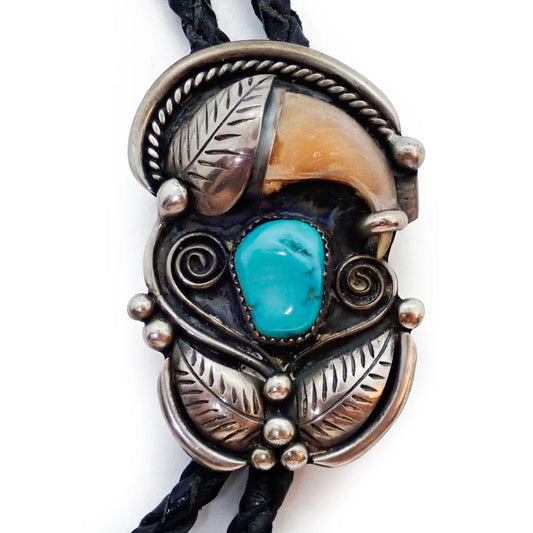
Vintage Navajo Sleeping Beauty Turquoise & Honey-Amber Bear Claw Sterling Silver Bolo Tie
Regular price $340.00 USDRegular priceUnit price per


Vintage Navajo Sleeping Beauty Turquoise & Honey-Amber Bear Claw Sterling Silver Bolo Tie
✨ Collectors Circle Members receive a welcome offer
At a Glance:
Design: Native American compact bolo tie with turquoise cabochon and claw, in a classic Western slide form
Stone: Turquoise visually consistent with Sleeping Beauty material
Color: Saturated blue turquoise with minimal matrix
Accent: Genuine animal claw, visually consistent with bear based on morphology, framed by raised leaf appliqués
Metal: .925 sterling silver, unmarked
Attribution: Consistent with Navajo work
Era: Likely 1980s
Status: Unsigned and unstamped vintage Native American bolo tie with clip-style clasp
Condition: Very Fine — see SCJ Vintage Condition GuideSpecifications:
- Wear scale: traditional small-to-medium bolo slide size
- Stone: 3/4" x 11/16" (bezel to bezel)
- Slide: 2 1/4" x 1 1/2"
- Total length (including tips): 45"
- Cord: like-new black braided leather with light marks from installation through the slide clip
- Tips condition: gently worn with light patina
- Clasp: unmarked clip-style
- Weight: 51.1 grams
Gallery Note:
This handcrafted Native American bolo tie is unsigned, a detail consistent with many mid- to-late 20th century Navajo pieces. In the absence of a hallmark, the piece speaks through its materials, silverwork, and composition, which align with Diné jewelry traditions. The pairing of turquoise and claw has deep roots in Native American jewelry, bringing together stone, silver, and natural elements in a compact Western format.
The turquoise provides a vivid blue focus, while hand-chased leaf appliqués frame the composition with quiet restraint. The genuine animal claw features a warm honey-amber tone — lighter than the dark brown or near-black examples most collectors encounter. While the lighter color may initially suggest cougar, the morphology — specifically the broad base and gradual arc — is more consistent with bear, as mountain lion claws tend to be slender and more sharply curved. We present this claw here as genuine and visually consistent with a bear, with the lighter amber tone noted for collectors who want to examine it further.
Finished with black braided leather and gently patinated silver tips, this bolo has the grounded presence collectors look for in traditional Navajo work — symbolic, rooted in heritage, and timeless.
Hallmark & Maker Notes:
This bolo tie is unsigned and carries no visible sterling stamp. The Navajo attribution is based on the materials, construction, and overall character. The clip-style clasp is also unmarked, and the absence of a visible patent stamp supports a post-1983 production window when evaluated alongside the overall fabrication.
✨ Collector inquiries are welcome. SCJ is open to thoughtful questions, documented observations, and new information that deepens the story of a piece. With permission, selected comments from our Members may be featured in our upcoming Collectors Circle Insights publications.
$340.00
-
Statement Piece

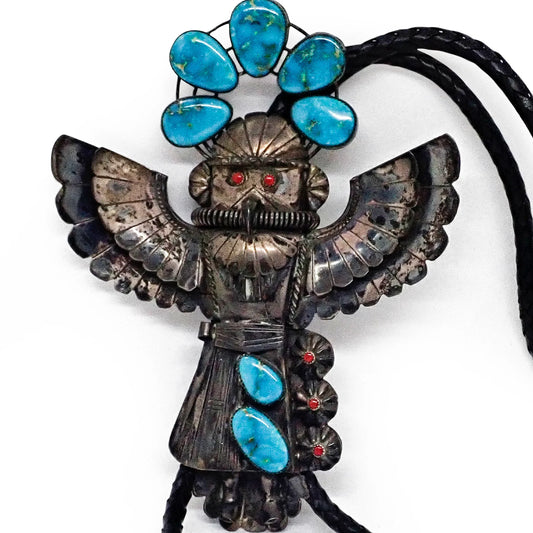
180-gram Massive Southwestern Navajo Turquoise & Coral Sterling Silver Eagle Dancer Kachina Bolo Tie by PETE MORGAN & BROKEN ARROW TRADERS
Regular price $2,680.00 USDRegular priceUnit price per


180-gram Massive Southwestern Navajo Turquoise & Coral Sterling Silver Eagle Dancer Kachina Bolo Tie by PETE MORGAN & BROKEN ARROW TRADERS
✨ Collectors Circle members receive a welcome offer
At a Glance:
Design: Native American extra-large Eagle Dancer kachina bolo tie
Stone: Seven turquoise cabochons consistent with Turquoise Mountain material
Color: Seven vivid blue matched turquoise stones
Accent: Five red-orange coral accents with layered silver appliqués, twisted-wire borders, fan and wing elements, and added hand-fabricated silverwork applied to the main slide
Metal: .925 sterling silver
Artist: Signed "M" stylized initial associated with Navajo artist Pete Morgan | Broken Arrow Traders shop mark, associated with Kay Johnson
Era: Late 20th century
Status: Signed and shop-stamped large-scale Southwestern collector bolo tie
Condition: Very Fine — see SCJ Vintage Condition GuideSpecifications:
- Wear scale: extra-large statement slide — spans the upper chest
- Largest turquoise: 1" x 5/8" (bezel to bezel)
- Slide: 6 3/4" x 5"
- Total length (including tips): 38 1/2"
- Cord: thick, black braided leather with light wear from slide movement
- Tips & ferrules condition: heavy-gauge sterling, gently worn with moderate patina
- Clasp: double-ring slide back
- Weight: 180.9 grams
Gallery Note:
This Eagle Dancer kachina bolo tie is a dramatic 1980s Navajo-Anglo Southwestern workshop statement piece produced under the Broken Arrow Traders brand and bearing a Pete Morgan-associated hallmark. Its oversized figural form, layered construction, and weight place it firmly within the bold studio-made tradition collected as wearable Southwest art.
The striking Eagle Dancer with outstretched wings is a motif deeply rooted in Hopi and Pueblo ceremonial tradition, and it became widely adopted in 20th-century commercial Southwestern jewelry produced across tribal lines. The piece is richly adorned with saturated blue turquoise cabochons and red-orange coral accents; together, these stones create a dynamic contrast against the dark sterling surface. The intricate silverwork on the slide and the fully dressed leather embellished with substantial sterling tips and ferrules add dimension, movement, and a commanding presence to the piece.
This bolo tie has the scale and visual force of sculptural jewelry rather than conventional Southwestern neckwear. It is especially suited to collectors drawn to extra-large pieces, kachina-inspired design, and high-impact Native American jewelry forms.
Hallmark & Maker Notes:
This bolo carries two stamped marks: a stylized capital M and the shop mark of Broken Arrow Traders, the Arizona-based silversmithing workshop operated by Kay Johnson, an Anglo artisan known for handmade sterling Southwestern jewelry in the traditional bench-made tradition. Johnson works alongside Bruce Johnson, identified in market-level post information as his son, a fellow silversmith and goldsmith involved in the shop’s active inventory and secondary-market presence.
The stylized M on this piece appears to be a variant form and does not match the standard Pete Morgan hallmark documented in major reference guides. A Navajo jewelry specialist reviewed photos of the hallmark and informally attributed the mark to Pete Morgan — a Navajo (Diné) silversmith and member of one of the better-known families in contemporary Navajo revival silverwork. Pete is the brother of the late master silversmith Harry Morgan and sandcast artist Henry Morgan, and the nephew of silversmiths Charlie Bitsui and Ike Wilson, both prominently represented in the historic C.G. Wallace Collection. The specialist noted that she has seen this same variant mark on other Broken Arrow Traders pieces, supporting a possible recurring workshop association between Pete Morgan and Kay Johnson's shop rather than a one-time occurrence.
SCJ presents this piece as a dual-marked, shop-stamped Broken Arrow Traders bolo tie with a Pete Morgan-associated hallmark. It is best understood within the collaborative world of Southwestern workshop production, where maker, shop, and market attribution can overlap in complex but meaningful ways.
✨ Collector inquiries are welcome. SCJ is open to thoughtful questions, documented observations, and new information that deepens the story of a piece. With permission, selected comments from our Members may be featured in our upcoming Collectors Circle Insights publications.
$2,680.00
-
Genuine Claw

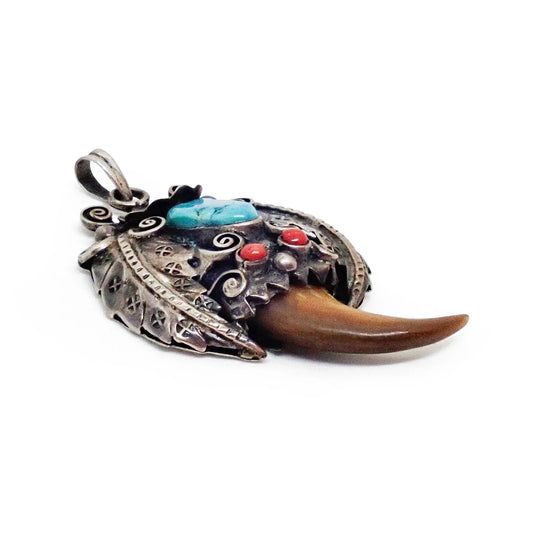
Native American Kingman Turquoise Coral & Bear Claw Sterling Silver Pendant Signed
Regular price $295.00 USDRegular priceUnit price per


Native American Kingman Turquoise Coral & Bear Claw Sterling Silver Pendant Signed
✨ Collectors Circle members receive a welcome offer
At a Glance:
Design: Native American bear claw sterling pendant with turquoise, coral, and intricate silverwork
Stone: Turquoise cabochon consistent with Kingman material
Color: Saturated sky-blue turquoise with minimal matrix
Secondary Stone(s): Two small red-orange coral accents
Accent: Layered wirework, chased leaves, and flower appliqués
Metal: .925 sterling silver
Artist: Signed J.M. | Navajo silversmith under active research
Era: Late 20th century
Status: Vintage Native American jewelry piece with partially faded hallmark
Condition: Very Fine — see SCJ Vintage Condition GuideSpecifications:
- Wear scale: mid-size pendant (chain not included)
- Turquoise: 5/16" x 5/16" (bezel to bezel)
- Width: 1 1/4"
- Total length (including the bail): 2 1/4"
- Bail: compact, best suited for fine to medium weight chain
- Weight: 13.1 grams
Gallery Note:
This Native American bear claw pendant brings together symbolic strength, saturated color, and detailed silverwork in a compact yet commanding form. A vivid sky-blue turquoise cabochon anchors the upper center, framed by curling wirework and layered sterling silver appliqué, while two red-orange coral accents introduce warmth beneath the stone.
The turquoise-and-coral contrast gives the pendant a classic Southwestern presence, while the genuine bear claw adds visual weight and traditional collector interest. Its mid-size scale keeps the piece wearable, but the layered silverwork, strong materials, and symbolic form give it a bold presence beyond its size.
Compact yet expressive, this pendant reflects the appeal of vintage Native American jewelry with strong visual character, meaningful materials, and construction details consistent with Navajo work.
Hallmark & Maker Notes:
The reverse bears a partially faded hallmark that appears to read “J.M.” beside a clear STERLING stamp. The maker remains under active research, as the mark has not yet been conclusively matched to a single documented silversmith.
The Navajo attribution is based on the pendant’s genuine bear claw element, sterling silverwork, turquoise-and-coral arrangement, curling wire accents, layered appliqué, and overall late 20th-century Navajo jewelry vocabulary — elements consistent with Navajo work, though maker identification remains unconfirmed due to the softened hallmark.
✨ Collector inquiries are welcome. SCJ is open to thoughtful questions, documented observations, and new information that deepens the story of a piece. With permission, selected comments from our Members may be featured in our upcoming Collectors Circle Insights publications.
$295.00
-
Circa 1940s

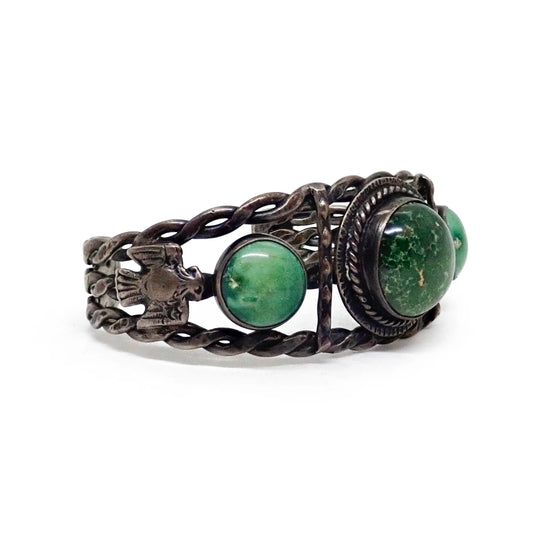
Harvey Era Navajo Natural Cerrillos Turquoise Trio Twisted Wire Sterling Silver Cuff Bracelet
Regular price $395.00 USDRegular priceUnit price per


Harvey Era Navajo Natural Cerrillos Turquoise Trio Twisted Wire Sterling Silver Cuff Bracelet
✨Collectors Circle Members receive a welcome offer
At a Glance:
Design: Native American cuff with a graduated three-stone turquoise arrangement and twisted flat-wire shank with eagle motifs
Stone: Natural turquoise consistent with Cerrillos material
Color: Green turquoise, ranging from deep forest green at the center to brighter open green at the shoulders
Accent: Applied eagle motifs flanking the side stones
Metal: .925 sterling silver, unmarked
Attribution: Navajo work associated with the late Harvey Era
Era: Circa 1940s
Status: Unsigned and unstamped turquoise trio sterling cuff
Condition: Excellent — see SCJ Vintage Condition GuideSpecifications:
- Wear scale: high profile, medium scale cuff — noticeable without excess
- Largest stone: approx. 3/4" (bezel to bezel)
- Face width: 1"
- Inside length: 5 1/4"
- Gap: 1 1/4"
- Total inside circumference: 6 1/2" (M per SCJ size guide)
- Weight: 37.3 grams
Gallery Note:
This late Harvey-era Navajo cuff centers on a classic trio of domed turquoise cabochons, arranged in graduated order with a clear central focus. The exquisite stones span the green palette, creating a color story closely associated with Cerrillos deposits, long prized for their rich hues and natural variation. Their high-luster surface and exceptionally preserved condition give the bracelet a refined presence.
The silverwork is restrained but assured. A heavy-gauge twisted flat-wire shank gives the cuff structure and tactile movement, while two small hand-chased eagle appliqués flank the side stones with quiet symmetry. With a 1" face and a high profile, this cuff has presence without becoming oversized. It's an elegant choice as a stand-alone or for layered pairings. Timeless and quietly expressive, it reflects the subtle confidence of mid-century Native American silverwork.
Hallmark & Maker Notes:
This bracelet is unsigned and carries no silver purity stamp, a practice consistent with the norm of the period. The absence of a maker's mark is also common in pre-1970s silversmithing, when pieces were made for tourists, trading posts, and curio markets, with an emphasis on designs, wearability, and production rather than individual maker identification.
The attribution is based on the bracelet’s overall language. The three-stone layout, measured ornament, wearable proportion, and controlled design are elements associated with late Harvey-era silverwork created for understated sophistication rather than authorship.
✨ Collector inquiries are welcome. SCJ is open to thoughtful questions, documented observations, and new information that deepens the story of a piece. With permission, selected comments from our Members may be featured in our upcoming Collectors Circle Insights publications.
$395.00
-
Nevada Turquoise

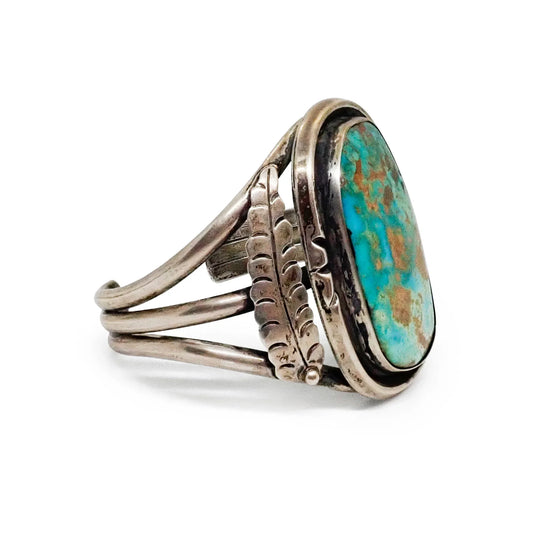
Vintage Native American Navajo Nevada Turquoise Sterling Silver Cuff Bracelet
Regular price $1,017.00 USDRegular priceUnit price per


Vintage Native American Navajo Nevada Turquoise Sterling Silver Cuff Bracelet
At a Glance:
A substantial Native American turquoise cuff with strong visual balance
Turquoise cabochon consistent with Nevada material
Strong and minimalist shank
Understated feather appliqués flank the centerpiece stone
Construction and design aligned with Navajo workBracelet Features:
- .925 sterling silver (unmarked)
- Vivid blue-green turquoise with golden-brown matrix
- Heavy-gauge silver construction
- Split-shank design
- Applied chased feather motifs
- Unsigned
- Condition: Very Fine — see SCJ Vintage Condition Guide
Bracelet Specifications:
- Wear scale: medium statement cuff with grounded presence.
- Turquoise: 1 11/16" x 1" (bezel to bezel)
- Face width: 2 1/16"
- Inside length: 5 1/2"
- Gap: 1 1/16"
- Total inside circumference: 6 9/16" (L per SCJ size guide)
- Weight: 63.4 grams
ABOUT THIS PIECE:
This bracelet is built around a single commanding stone.
The cabochon presents a saturated blue-green field on a golden-brown host rock, a characteristic often associated with Nevada turquoise. The matrix forms irregular islands across the surface, creating contrast and depth without visual weight.
The surrounding silverwork remains restrained, with a quiet, smooth finish that emphasizes the stone. The open split shank balances the composition while supporting the centerpiece. Applied feather motifs add texture and dimension, introducing a traditional Native American element within a controlled, uncluttered design. There's a clear sense of presence here, yet the cuff maintains a composed profile. It reads as a bold single-stone piece with defined structure and proportion.
PERFECT FOR:
- Collectors of Navajo turquoise jewelry
- Those drawn to bold matrix patterns
- Anyone who appreciates medium-size statement cuffs
- Southwestern, Western, and elevated Boho-Chic styling
- Pairing with turquoise rings or wearing as a single focal piece
✨ Collectors Circle members receive a welcome offer on their first purchase.
$1,017.00
- .925 sterling silver (unmarked)


