


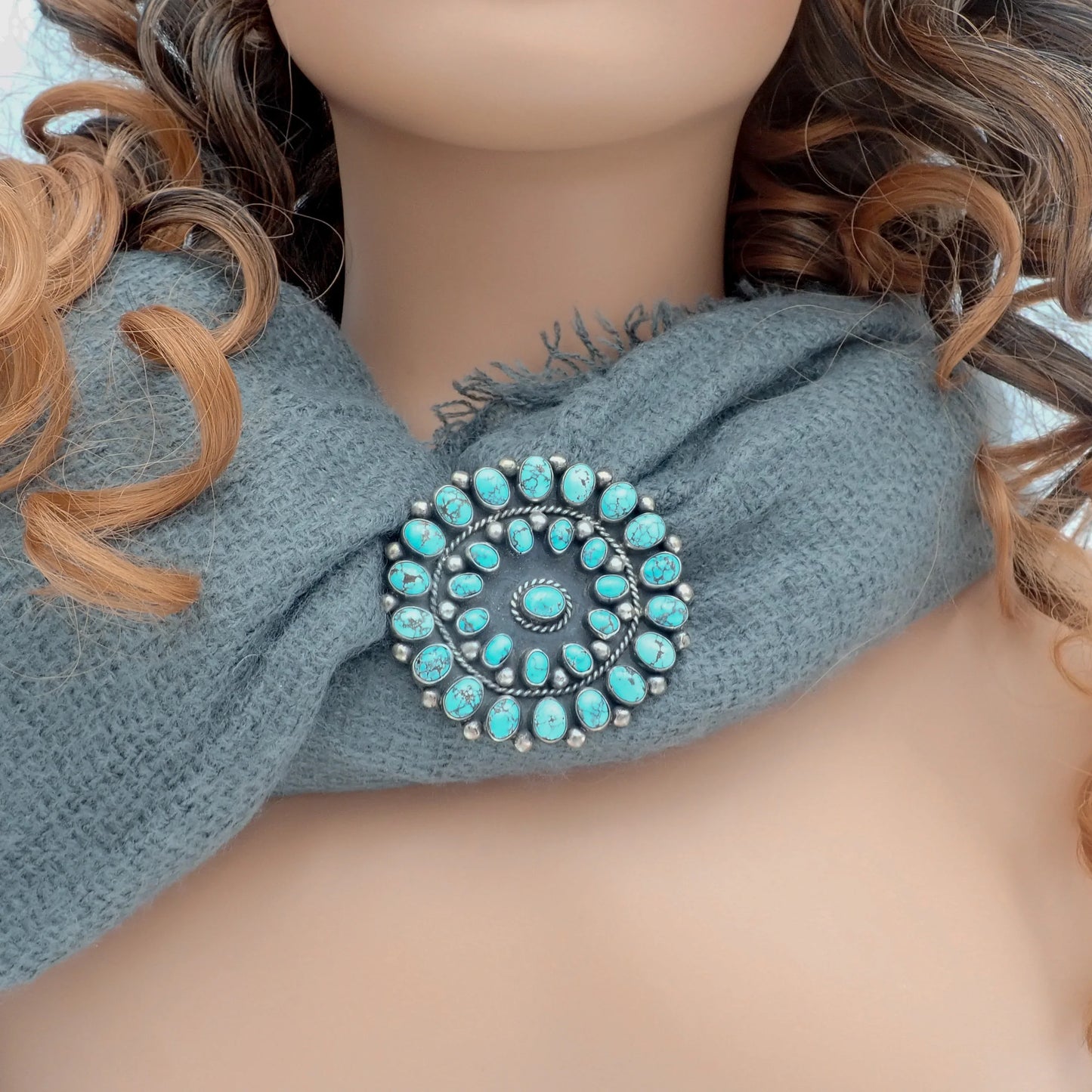
Tobe Turpen 1950s Persian Turquoise Cluster Navajo Pin Brooch
Skip to content


SKU:00054PMNJ13017
Couldn't load pickup availability

Unlock Complimentary Shipping
Join the Collectors Circle for exclusive benefits
✨ Collectors Circle members receive a welcome offer
Design: Mid-Century trading post Navajo turquoise cluster sterling pin brooch with hand-laid rosette construction
Stone: Thirty high-domed turquoise cabochons consistent with Persian material
Color: Fine spiderweb matrix with natural variation, spread across a cluster that ranges from sky to vivid blues
Accent: Handmade and hand-assembled rope details with silver shots
Metal: .925 sterling silver (unmarked)
Attribution: Engraved TT | Tobe Turpen trading post
Era: Circa 1950s, postwar trading-post period
Status: Shop-marked turquoise cluster, unmarked silver pin brooch associated with Navajo work (not artist-signed)
Condition: Excellent — see SCJ Vintage Condition Guide
This turquoise cluster brooch carries the quiet authority collectors look for in trading-post jewelry: a hand-built turquoise cluster, a substantial silver backplate, original pin assembly, and a maker's mark associated with a historical Gallup trading post.
The bezels were hand-formed, the cabochons were hand-assembled, and the stones were individually placed in concentric rings with a clear center point. The layout achieves the kind of symmetry only a human hand can produce — balanced in overall composition, with natural variations in spacing, dome height, stone shape, and accent alignment that come from working by eye rather than by template. That hand-laid quality gives the brooch a sense of order without stiffness — a balanced cluster with the natural rhythm of the era's bench-made work.
The matched turquoise brings brightness and depth to the composition. Color moves from a softer sky-blue to more saturated shades, with a fine spiderweb matrix visible throughout the cluster. A longtime former owner of a Southwestern trading post, familiar with vintage turquoise, identified the material as likely Persian turquoise based on dome style, character, and period context. The attribution was subsequently confirmed by SCJ's appraiser, and it's therefore presented as an informed visual assessment by two industry professionals, rather than a laboratory origin analysis. While Iranian turquoise is most famous for a clear robin's egg appearance, documented examples show spiderweb Persian turquoise developed a following of its own in the U.S. According to reference material, the import of Persian turquoise began in the early 1890s and continued until 1979, when the U.S. implemented the first major wave of trade sanctions, cutting off most direct imports from Iran.
The silverwork supports the cluster without distracting from it. The heavier backplate gives the brooch substance, while handmade rope details and silver balls add texture and dimension between the stones. The original pin assembly and unmarked silver content are consistent with older Native American jewelry made for trading-post circulation, where shop marks, purity stamps, and artist signatures were not always applied with modern consistency.
This brooch is stamped TT on the reverse — a mark documented in reference sources as the retail shop control mark of Tobe Turpen’s Trading Post in Gallup, New Mexico. It is a shop mark, not an artist’s signature, and does not identify the individual maker.
That distinction matters. A related mark — a tilde, sometimes accompanied by TT — is associated with Fred Thompson (1922–2002), a Diné silversmith whose career began at age 15 working for Turpen and whose jewelry remained closely tied to the post through the 1950s. This brooch carries the plain TT mark, without the tilde, placing it with the shop’s control mark rather than Thompson’s personal hallmark.
The Turpen family story reaches back to the early 1900s, when Tobe Turpen Sr. came west from Texas and entered the trading business through family connections in Arizona. He worked in reservation trade settings, learned the Navajo language at Blue Canyon, moved through the Gallup network, and in 1939 opened his own post in a building purchased from J. L. Hubbell on North Third Street.
After World War II, Tobe Turpen Jr. joined his father in the business and later took ownership in the mid-1950s. As highway construction and changing travel routes reshaped Gallup, the post eventually relocated from North Third Street to South Second Street. During the boom years of Native American jewelry collecting, Tobe Turpen’s supplied retailers far beyond Gallup and built a strong reputation among dealers for quality material, active trade relationships, and steady jewelry placement.
The reverse of this brooch adds another layer to that working history. In addition to the TT shop mark, the back shows a scratched notation that appears to read “MIOE” or similar, with a small cross mark below it, along with remnants of two old paper tags. These are consistent with practical shop, pawn, inventory, or resale notations — the kind of back-of-piece marks used as jewelry moved through retail and trading channels. They are not maker’s marks and do not change the attribution.
This is where the broader story comes into focus. Rail and highway travel helped introduce Native American and Southwestern silverwork to a wider public, but Gallup posts helped sustain the production networks behind it. They connected makers, materials, buyers, wholesalers, and retailers at the point where jewelry was still being shaped by hand, stone by stone and setting by setting.
For collectors, that matters because jewelry associated with mid-century trading-post production often retains the character of individual bench work rather than strict duplication from a single master pattern. This brooch reflects that moment: demand was expanding, the market was reaching farther, but fabrication still depended on the maker’s eye and hand. SCJ presents the piece as a Tobe Turpen-associated, Navajo-made turquoise cluster brooch from the postwar Gallup trading-post period, with no individual maker assigned.
✨ Collector inquiries are welcome. SCJ is open to thoughtful questions, documented observations, and new information that deepens the story of a piece. With permission, selected comments from our Members may be featured in our upcoming Collectors Circle Insights publications.
1. All items in our inventory are pre-loved vintage pieces, and even those described as in “excellent” condition may display very minor imperfections from previous ownership. We make every effort to provide clear photos of any visible irregularity so you can make an informed decision before making your purchase.
Each product description page includes the item's vintage condition classification and a Condition Guide to help you understand the overall condition of the silverwork and stones. Please note:
2. The measurements are given as close approximations, and slight variations may occur.
3. Every photo represents the exact piece you’ll receive, shown in its actual color and condition. While the jewelry itself is never altered, backgrounds are edited to ensure a clean, consistent display.
4. Because screens display colors differently, the exact shade of a piece may vary slightly from one device to another. If you’re looking for a piece to match an item you already own, we suggest viewing the product's photos on multiple devices for the most accurate assessment of color and overtones.
5. At Silver Cactus Jewelry, we are committed to honoring cultural integrity and accurately representing Indigenous art in accordance with the Indian Arts and Crafts Act. We carefully describe each piece in good faith, with complete transparency regarding signed or unsigned status, available provenance, and expert opinion. Attributions to specific artists or tribes are based on expert evaluation but are not guaranteed. Buyers are encouraged to make their own evaluations before purchase.
6. All jewelry is sold as-is. Buyers are responsible for ensuring compatibility with personal sensitivities (e.g., metal allergies).
7. Silver Cactus Jewelry’s liability is limited to the purchase price of the item. No additional warranties are expressed or implied.
Our Approach to Provenance
Every vintage piece carries a story that begins with its maker. Some are clearly signed and dated; others show only a softened hallmark, a sterling/.925 stamp, the place of production or tribal indicator
—and some bear no markings at all.
Evaluation of Unsigned, Unclear, or Unknown Marks
Pre-loved vintage jewelry rarely includes formal documentation. When hallmarks are unclear or missing, we look to the piece itself for insight into provenance and authenticity. Our evaluation may include:
Attribution & Provenance Disclosure
Each piece is described in good faith and with careful attention to accuracy. We provide full transparency regarding whether a piece is signed or unsigned, any known or available provenance, and our informed professional assessment at the time of listing.
Attributions to specific artists, tribes, or mines are based on stylistic analysis, materials, construction techniques, historical context, and available reference material. In cases where hallmarks are unclear, partial, or absent, even recognized experts may reasonably differ in their conclusions. For this reason, all attributions should be understood as informed opinions rather than absolute guarantees.
Native American jewelry is a living tradition, and the learning process never truly ends. Our understanding continues to evolve through ongoing research and the exchange of knowledge with fellow collectors, scholars, artisans, and informed clients. This ongoing dialogue helps preserve accuracy, context, and integrity—ensuring we remain a trusted source of information rather than presenting any single interpretation as final.
Collectors who value this shared approach to learning are invited to join the Collectors Circle, where we exchange newly uncovered information, historical insights, and evolving perspectives on materials, makers, and regional traditions. This collaborative environment allows knowledge to grow responsibly and ensures that both collectors and researchers benefit from continued discovery.
We encourage collectors and enthusiasts to conduct their own independent evaluation prior to purchase. For a detailed explanation of our methodology, limitations, and guarantees, please refer to our Terms of Service.
For general questions, you may contact us at info@silvercactusjewelry.com.
A Word About Our Insurance Tag
Silver Cactus Jewelry pieces are vintage and one of a kind—often irreplaceable. To honor their history and protect your investment, each item is carefully inspected and secured with an Insurance Tag, ensuring it arrives as represented.
🛡️ Why the Insurance Tag Matters
⚠️ Important: Removing the Insurance Tag terminates the insurance and voids the return policy.
This safeguard preserves the integrity of rare collectibles while reinforcing our commitment to excellence and a client experience that meets or exceeds expectations. For detailed information about our insurance policy, please view our Terms of Service.
Once you are satisfied with your purchase, or after the return period has concluded, you may remove the Insurance Tag. In the unlikely event that any minor adhesive residue remains, a moist pad and jeweler’s cloth are included for gentle cleaning and light polishing.
For questions about your order, please contact us at support@silvercactusjewelry.com.
For Return Authorizations (RAs) or questions about returns, please review our Return Policy and contact us at returns@silvercactusjewelry.com.
For general questions, you can reach us at info@silvercactusjewelry.com.



[title]
[message]Love it? Add to your wishlist
Your favorites, all in one place. Shop quickly and easily with the wishlist feature!