


Indian Mountain Turquoise Sterling Navajo Cuff | G. Damon
Skip to content


SKU:00020BR1NJ11439
Couldn't load pickup availability

Unlock Complimentary Shipping
Join the Collectors Circle for exclusive benefits
✨ Collectors Circle Members receive a welcome offer on their first purchase.
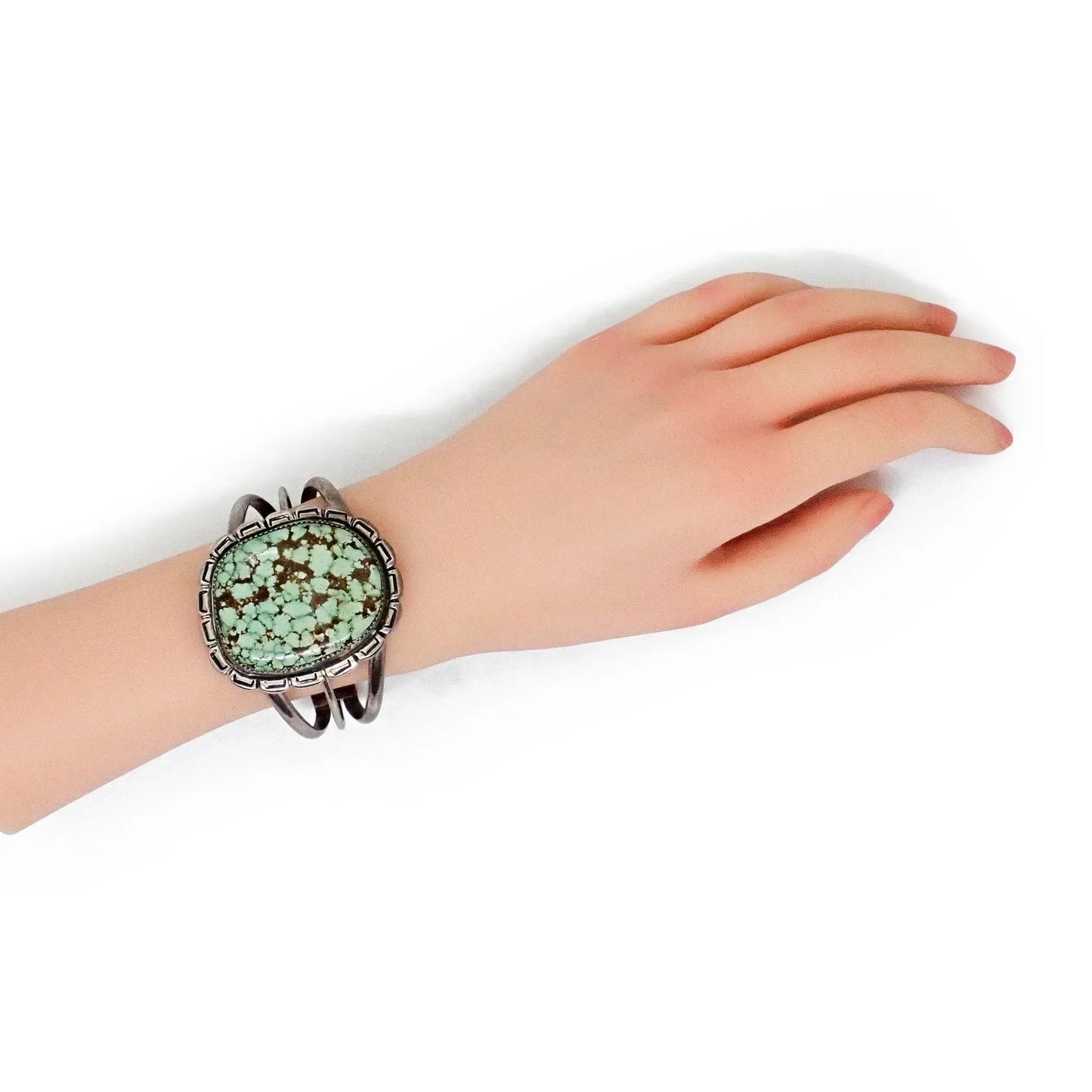
Design: Native American signed spiderweb turquoise cuff bracelet with clean three-tine Navajo construction and a stone-forward face
Stone: Spiderweb turquoise cabochon consistent with Indian Mountain
Color: Soft green and faint teal cells moving through dark brown host rock
Accent: Decorative segmented outer border
Metal: .925 sterling silver (unmarked)
Artist: Signed G | Gilbert Damon, Navajo silversmith
Era: Late 20th century (1970-80s)
Status: Signed Navajo spiderweb turquoise cuff bracelet
Condition: Very Fine — see SCJ Vintage Condition Guide
This signed Navajo cuff is defined by its turquoise: a richly webbed cabochon with teal-green cells moving through dark brown host rock. A complex and yet well-balanced matrix, with enough open green ground for the stone to read clearly and hold its presence on the wrist.
Damon’s silverwork keeps the setting clean and focused. A sawtooth bezel secures the cabochon and adds fine texture at the edge, while the stepped geometric border gives the face structure without crowding the stone. The three-tine shank is smooth, open, and deliberately understated, letting the turquoise remain the center of the design.
Reference and market examples more commonly associate Damon with chip inlay, making this large bezel-set spiderweb turquoise cuff a less common example of his documented range. For collectors, that contrast adds to its appeal — a signed Damon Gilbert in a stone-forward setting with restrained Navajo construction is a rare find.
Collector-minded without excess, this cuff earns its presence through the character of the stone and the clarity of the silverwork design.
This bracelet is signed with Gilbert Damon's hallmark — a stylized capital G, also associated in reference materials with the initials GD. His angular initial signature is reported to have been introduced around 1975, supporting the late-20th-century placement of this piece.
Damon was born June 20, 1930, in Fort Defiance, Arizona, into the Tsi'naajinii (Black Streak Wood People Clan), born for Tódich'ii'nii (Bitter Water Clan). He attended BIA Indian School in Fort Defiance, the Albuquerque Indian School, and Chilocco Indian School in Chilocco, Oklahoma.
He served in the Korean War — one of approximately 10,000 Native Americans who answered that call, many of them veterans of World War II as well, whose service and sacrifice remain an enduring part of this nation's history. He later spent 20 to 25 years employed with the Navajo Forest Products Industry in the Sawmill region in Arizona. He was a silversmith and family man who loved his children. He passed away on April 15, 2016, in Payson, Arizona.
Reference materials and market examples most commonly document Damon's work in chip inlay — crushed turquoise, coral, and related materials set into recessed silver channels, often with etched or oxidized geometric backgrounds. Authentic signed Damon pieces now enter the market through estate and secondary channels.
1. All items in our inventory are pre-loved vintage pieces, and even those described as in “excellent” condition may display very minor imperfections from previous ownership. We make every effort to provide clear photos of any visible irregularity so you can make an informed decision before making your purchase.
Each product description page includes the item's vintage condition classification and a Condition Guide to help you understand the overall condition of the silverwork and stones. Please note:
2. The measurements are given as close approximations, and slight variations may occur.
3. Every photo represents the exact piece you’ll receive, shown in its actual color and condition. While the jewelry itself is never altered, backgrounds are edited to ensure a clean, consistent display.
4. Because screens display colors differently, the exact shade of a piece may vary slightly from one device to another. If you’re looking for a piece to match an item you already own, we suggest viewing the product's photos on multiple devices for the most accurate assessment of color and overtones.
5. At Silver Cactus Jewelry, we are committed to honoring cultural integrity and accurately representing Indigenous art in accordance with the Indian Arts and Crafts Act. We carefully describe each piece in good faith, with complete transparency regarding signed or unsigned status, available provenance, and expert opinion. Attributions to specific artists or tribes are based on expert evaluation but are not guaranteed. Buyers are encouraged to make their own evaluations before purchase.
6. All jewelry is sold as-is. Buyers are responsible for ensuring compatibility with personal sensitivities (e.g., metal allergies).
7. Silver Cactus Jewelry’s liability is limited to the purchase price of the item. No additional warranties are expressed or implied.
Our Approach to Provenance
Every vintage piece carries a story that begins with its maker. Some are clearly signed and dated; others show only a softened hallmark, a sterling/.925 stamp, the place of production or tribal indicator
—and some bear no markings at all.
Evaluation of Unsigned, Unclear, or Unknown Marks
Pre-loved vintage jewelry rarely includes formal documentation. When hallmarks are unclear or missing, we look to the piece itself for insight into provenance and authenticity. Our evaluation may include:
Attribution & Provenance Disclosure
Each piece is described in good faith and with careful attention to accuracy. We provide full transparency regarding whether a piece is signed or unsigned, any known or available provenance, and our informed professional assessment at the time of listing.
Attributions to specific artists, tribes, or mines are based on stylistic analysis, materials, construction techniques, historical context, and available reference material. In cases where hallmarks are unclear, partial, or absent, even recognized experts may reasonably differ in their conclusions. For this reason, all attributions should be understood as informed opinions rather than absolute guarantees.
Native American jewelry is a living tradition, and the learning process never truly ends. Our understanding continues to evolve through ongoing research and the exchange of knowledge with fellow collectors, scholars, artisans, and informed clients. This ongoing dialogue helps preserve accuracy, context, and integrity—ensuring we remain a trusted source of information rather than presenting any single interpretation as final.
Collectors who value this shared approach to learning are invited to join the Collectors Circle, where we exchange newly uncovered information, historical insights, and evolving perspectives on materials, makers, and regional traditions. This collaborative environment allows knowledge to grow responsibly and ensures that both collectors and researchers benefit from continued discovery.
We encourage collectors and enthusiasts to conduct their own independent evaluation prior to purchase. For a detailed explanation of our methodology, limitations, and guarantees, please refer to our Terms of Service.
For general questions, you may contact us at info@silvercactusjewelry.com.
A Word About Our Insurance Tag
Silver Cactus Jewelry pieces are vintage and one of a kind—often irreplaceable. To honor their history and protect your investment, each item is carefully inspected and secured with an Insurance Tag, ensuring it arrives as represented.
🛡️ Why the Insurance Tag Matters
⚠️ Important: Removing the Insurance Tag terminates the insurance and voids the return policy.
This safeguard preserves the integrity of rare collectibles while reinforcing our commitment to excellence and a client experience that meets or exceeds expectations. For detailed information about our insurance policy, please view our Terms of Service.
Once you are satisfied with your purchase, or after the return period has concluded, you may remove the Insurance Tag. In the unlikely event that any minor adhesive residue remains, a moist pad and jeweler’s cloth are included for gentle cleaning and light polishing.
For questions about your order, please contact us at support@silvercactusjewelry.com.
For Return Authorizations (RAs) or questions about returns, please review our Return Policy and contact us at returns@silvercactusjewelry.com.
For general questions, you can reach us at info@silvercactusjewelry.com.



[title]
[message]Love it? Add to your wishlist
Your favorites, all in one place. Shop quickly and easily with the wishlist feature!