


-
1950s

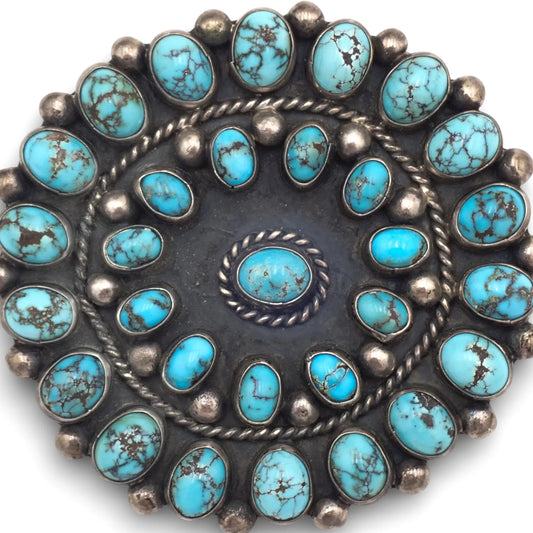
1950s Native American Navajo Persian Turquoise Rosette Cluster Sterling Pin Brooch by TOBE TURPEN
Regular price $1,121.00 USDRegular priceUnit price per


1950s Native American Navajo Persian Turquoise Rosette Cluster Sterling Pin Brooch by TOBE TURPEN
At a Glance:
Native American turquoise cluster pin brooch
Attributed to the Tobe Turpen trading post, Gallup, New Mexico
Hand-laid rosette setting rather than template layout
High-domed turquoise cabochons consistent with Persian turquoise
Engraved “TT” shop control mark (not the artist's signature)
Post-war trading era collector's examplePin Features:
- .925 sterling silver (unmarked)
- Turquoise cluster with vivid blues and fine spiderweb matrix
- Individually formed bezels, hand-laid
- Hand-fabricated construction associated with Navajo work
- Original pin assembly
- Circa 1950s
- Hallmarked by the shop
- Condition: Excellent — see SCJ Vintage Condition Guide
Pin Specifications:
- Wear scale: medium-large statement — best suited for jackets, denim, or heavier fabrics
- Center turquoise: 1/4" x 5/16" (bezel to bezel)
- Diameter: 2 3/8"
- Weight: 41 grams — substantial for a brooch
ABOUT THIS PIECE:
This medium-large Native American cluster brooch bears a small, hand-engraved “TT” on the reverse, a mark associated with the Tobe Turpen trading post in Gallup, New Mexico, rather than a conventional artist signature.
From the back forward, the brooch shows construction details collectors tend to notice right away: a heavier silver backplate, individually formed bezels, and an older pin assembly consistent with mid-century bench work. The build is straightforward and solid, with each component formed and assembled by hand rather than derived from standardized parts.
The front carries a clear, balanced composition. The stones are arranged in concentric rings that create a rosette-like structure, drawing the eye inward and then back across the surface. Color shifts from softer sky-blue to more vivid blue, and the contrast against the darkened silver gives the brooch brightness and depth without overwhelming the form.
Stone identification is based on visual assessment rather than laboratory testing. A longtime former Southwestern trading post owner familiar with vintage turquoise identified the stones as likely Persian turquoise based on dome, appearance, and period context. While Iranian turquoise is often associated with clear sky-blue material, documented examples can also show spiderweb matrix, so matrix alone does not exclude that reading.
Up close, the individuality of each stone becomes more apparent. The cabochons are not mechanically matched; slight differences in dome height, spacing, and matrix create a natural rhythm across the surface. The silverwork keeps the composition grounded, so the piece feels resolved without becoming rigid.
The brooch is not stamped sterling, which aligns with earlier Native American jewelry made for trading-post circulation, where purity and maker marks were not always applied consistently.
Taken together, the Turpen-associated mark, hand-built cluster layout, older pin assembly, and overall construction place the brooch most comfortably in a mid-century trading-post context, likely postwar rather than later studio production.
ATTRIBUTION NOTE:
By the 1930s, travelers were already encountering Southwestern jewelry along the railroad corridors and emerging highway routes, with the Fred Harvey network helping introduce these forms to a national audience.
In Gallup, trading posts operated alongside that growing interest but served a different role. When Tobe Turpen opened his shop in 1939, the store functioned not only as a retail counter but as part of a working exchange. Silversmiths arrived with finished pieces, obtained silver and stones, or accepted requests for specific forms, while the final decisions were still made at the bench.
In that sense, the rail and highway trade broadened appreciation for Southwestern jewelry, while Gallup trading posts helped sustain the production networks behind it. Jewelry associated with trading-post production often retains the character of individual bench work rather than strict duplication from a single master pattern, reflecting a mid-century moment when demand was expanding but fabrication still depended heavily on the maker’s hand.
PERFECT FOR:
- Collectors of mid-century Native American jewelry
- Those drawn to early trading-post pieces and turquoise cluster work
- Southwestern statement styling
- Adding substance to lapels, denim, or woven jackets
- Pairing with turquoise necklaces and silver bead strands
✨ Collectors Circle members receive a welcome offer on their first purchase.
$1,121.00


